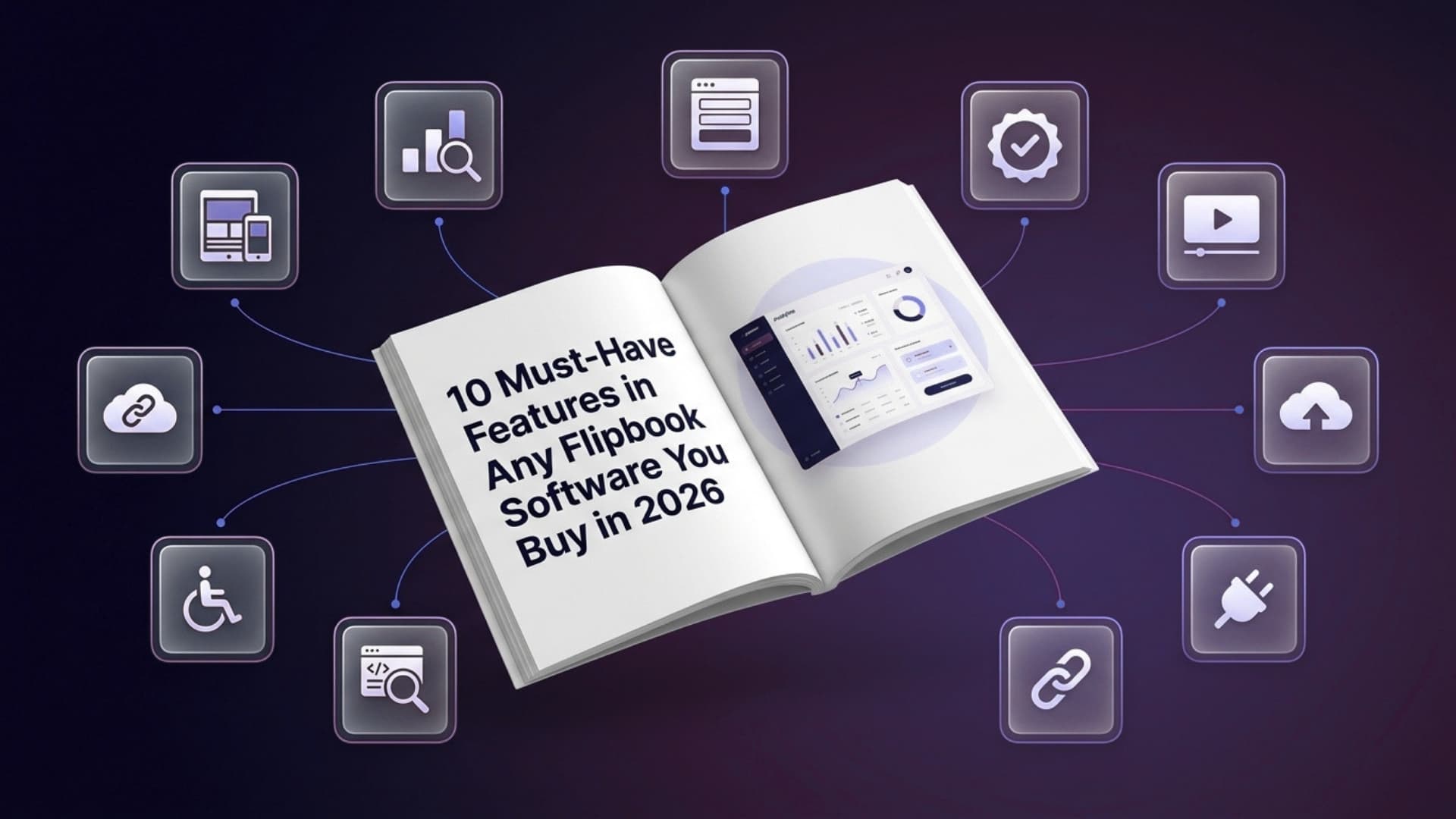
10 Must-Have Features in Any Flipbook Software You Buy in 2026
Looking for the best flipbook software in 2026? Here are the 10 features that separate tools worth buying - covering everything from analytics to accessibility.
Written By: Jagadish C U (Founder Of Zentrovia Solutions)
10 Essential Flipbook Software Features for Modern Publishing
Choosing the best flipbook software in 2026 is not as simple as picking the tool with the flashiest demo. The market has matured, reader expectations have shifted, and the gap between a basic PDF-to-flipbook converter and a full-featured digital publishing platform has never been wider.
Whether you are building interactive annual reports, digital brochures, product catalogues, or client-facing proposals, the software you choose will directly affect how your content performs - on search, on mobile, with your audience, and inside your own analytics stack.
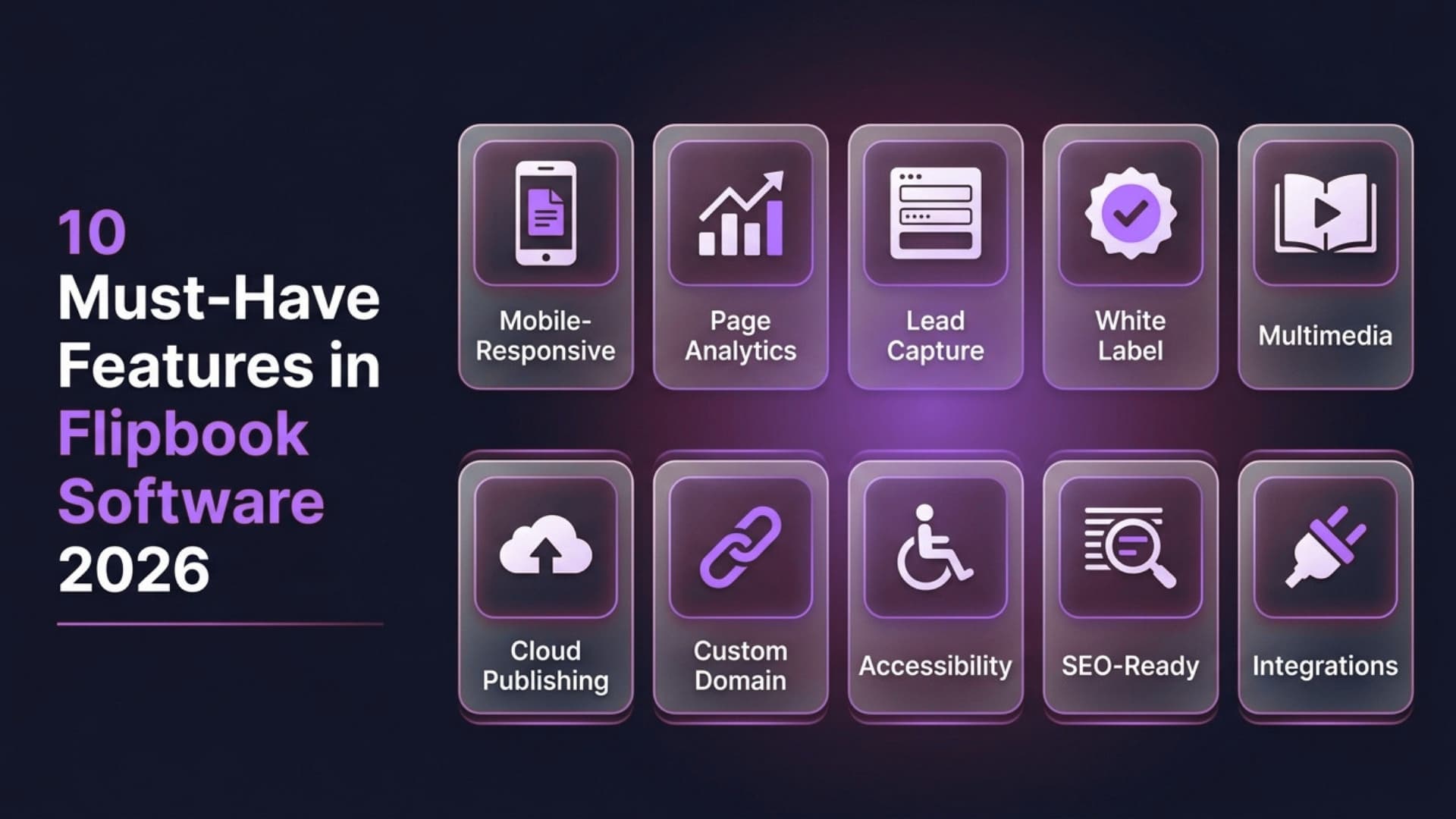
This guide covers the 10 features every buyer should verify before committing to any flipbook software in 2026. Each one is drawn from what ZenFlip has built and what real publishing teams look for when they evaluate tools in this category.
1. Mobile-Responsive Design
In 2026, the majority of digital content is consumed on mobile devices. Any flipbook software worth buying must render your publications cleanly across screen sizes - phones, tablets, and desktops - without requiring the reader to pinch, zoom, or scroll horizontally to read a sentence.
True mobile responsiveness means the layout adapts, not just scales. Text reflows, images resize, and the reading experience feels native on each device. When evaluating tools, open a test publication on your own phone before you sign anything. If it does not feel smooth and readable, move on.
ZenFlip builds mobile-first rendering into every publication so your content works for readers wherever they open it.
Read: Mobile Accessibility for Digital Publications: Touch Targets, Gestures, and WCAG
2. Page-Level Analytics
Knowing that someone opened your flipbook is useful. Knowing which pages they spent time on, where they dropped off, and which links they clicked is what drives decisions.
Page-level analytics give content teams the data they need to improve future publications. If readers are consistently leaving before page 8 of a 12-page report, that is actionable insight. If a particular product page in a catalogue is generating the most clicks, that tells your team where to invest more creative effort.
Look for software that provides per-page engagement data, average time on page, and link-click tracking - not just total views and open rates.
Read: How to Use Page-Level Analytics to Improve Your Digital Publication in 2026
3. Lead Generation Forms
Flipbooks that live on public URLs are marketing assets. The best flipbook software in 2026 allows you to embed lead generation forms directly inside your publications - gating a download, a follow-up resource, or a contact form without routing readers away from the content.
This feature turns passive readers into trackable leads without interrupting the reading experience. It is particularly valuable for sales teams using digital brochures and product catalogues as part of their outreach.
ZenFlip supports embedded forms within publications, connecting content engagement directly to your lead pipeline.
Read: Lead Capture Strategies for Digital Publications
4. White Label Branding
If you are producing flipbooks for clients, or if you simply want your publications to look like they came from your brand and not from a software company, white label flipbook capability is non-negotiable.
White labelling means removing the platform's own branding from the interface - no "powered by" badges, no external logos, no platform-branded loading screens. Your domain, your logo, your colours. Nothing else.
This matters in pitches, client deliverables, investor reports, and any context where the professionalism of the presentation is part of what you are selling. Platforms that charge a premium for white labelling or lock it to the highest tier are worth scrutinising carefully before you commit. Read: ZenFlip | Features | Custom Branding
5. Multimedia Embedding
Static PDFs converted to flipbooks are a starting point, not a destination. The interactive flipbooks that perform best in 2026 incorporate video, audio, image galleries, and embedded links that give readers something to engage with rather than just scroll past.
Multimedia embedding transforms a flat annual report into an interactive experience - a chairman's video message plays inline, a product demonstration auto-starts as a reader reaches that section, a clickable chart opens supporting data in a sidebar.
When evaluating tools, verify that embedding is native to the platform and does not require workarounds, external iframes, or technical configuration on every publication.
6. Cloud-Based Publishing
Cloud-based publishing means your flipbooks are hosted, managed, and distributed from the platform - no files to upload manually, no version-control headaches, and no dependency on your internal IT infrastructure to keep publications live and accessible.
In practical terms, this means updates can be made to a live publication without taking it offline or resending links to your audience. If you spot an error in a published annual report, you fix it in the platform and the correction goes live immediately - every existing link continues to work.
ZenFlip operates as a fully cloud-based platform, keeping publications always accessible and easy to update from anywhere.
7. Custom Domain and Embed Support
Your flipbook should live at your URL, not the platform's. Custom domain support means publications are served from your own subdomain - something like reports.yourbrand.com - rather than a generic platform link.
Embed support takes this further, allowing you to place your flipbook inside your website, blog, or landing page via a simple embed code. This keeps traffic on your own properties and reinforces brand consistency for readers who encounter your content through multiple channels.
Both custom domain and embed features are baseline requirements for any team serious about digital publishing in 2026. Treat them as standard, not as premium add-ons.
Read: ZenFlip | Features | Embedding
7.5 Content Access Control and Secure Publishing
Publishing your content publicly is one option. But a significant portion of high-value digital content - client-facing proposals, gated research, internal communications, member-only publications, and paid subscription content - needs to reach specific readers and no one else.
Flipbook software that includes content access control gives publishers the flexibility to serve both public and private content from the same platform. Password-protected flipbooks allow you to share a publication via link while restricting access to anyone without the correct credentials. Email gating prompts readers to submit their email address before unlocking full content - a low-friction approach that works well for audience building alongside access management.
For teams embedding publications on websites, a protected embed ensures your flipbook remains access-controlled even when placed on an external page - readers cannot bypass authentication simply by viewing the embed elsewhere.
As subscription publishing continues to grow in 2026, the ability to configure tiered access - different credentials per subscription level applied across multiple publications - is becoming a standard expectation rather than an advanced feature. Publishers managing member libraries, course platforms, or paid digital magazines should verify this capability is available before committing to any platform.
Look for: password protection, email gating, protected embeds, and tiered access control. If a platform charges separately for each of these or bundles them only into the highest tier, that is worth factoring into the total cost comparison
Read: White Label Content Monetization: How to Own Your Brand and Drive Digital Publishing Revenue
8. Document Accessibility Compliance
Accessibility is no longer optional. WCAG-aligned document accessibility compliance ensures your flipbooks can be read by users relying on screen readers, keyboard navigation, and assistive technologies.
This matters for legal compliance in many sectors, particularly for organisations publishing annual reports, government communications, or educational content. It also matters for reach - accessible content serves a broader audience and avoids excluding readers based on disability.
When evaluating flipbook software, ask specifically about accessibility output. A tool that converts your PDF to a visual flipbook without retaining text accessibility loses the compliance foundation of your source document.
Read: Your Complete Guide to Accessible Digital Publications in 2026
9. SEO-Friendly Architecture
To create online annual reports and marketing publications that get discovered through search, your flipbook software needs to produce content that search engines can read, index, and rank.
This means text inside your flipbook should be crawlable - not locked inside an image layer or rendered as an unindexed canvas element. It means clean URL structures, the ability to set custom page titles and meta descriptions, and proper heading hierarchy within publication pages.
Platforms that render flipbook pages as static image layers or locked canvas elements are invisible to search engines. In 2026, that is a significant competitive disadvantage for any content team investing in digital publishing as an organic channel.
10. Integrations and API Access
The best flipbook software in 2026 does not operate in isolation. It connects to the tools your team already uses - CRM platforms, email marketing systems, analytics dashboards, and marketing automation workflows
API access gives technical teams the flexibility to build custom integrations, automate publication workflows, and pull performance data into existing reporting infrastructure. Out-of-the-box integrations with common tools reduce the time between publishing and acting on what your content is telling you.
Before you finalise any purchasing decision, map the integrations you actually need against the list of what the platform natively supports. A tool that performs well in isolation but creates data silos is a tool that adds friction to your workflow over time.
Read: ZenFlip | Features | Integration
AI-Powered Features in Flipbook Software: What to Look for in 2026
Artificial intelligence has moved from an emerging addition in digital publishing tools to a core part of how the strongest flipbook platforms deliver value in 2026. Understanding which AI capabilities are genuinely useful — and which are superficial additions — is now a meaningful part of the flipbook software buying decision.
AI Chat for Documents: Turning Flipbooks into Responsive Resources
The most impactful AI feature in flipbook software in 2026 is embedded AI chat for documents. This capability allows readers to ask questions about a publication's content in natural language and receive direct answers sourced from the document itself — with page citations indicating exactly where the information lives.
The practical value of this feature depends on the type of content being published. Long-form documents — technical guides, compliance handbooks, product catalogues, employee training manuals, and annual reports — contain information that readers need to locate quickly rather than read linearly. An embedded AI document assistant reduces the time from question to answer from minutes of manual searching to seconds of conversational retrieval.
ZenFlip includes ZenGuy AI with source citations. When a reader asks a question through ZenGuy, the response is sourced from the flipbook's own content with a citation pointing to the specific page — keeping the document as the authority while making its information immediately accessible.
AI Vision Page Descriptions: Accessibility and Discoverability
AI vision page descriptions analyses the visual and textual content of each flipbook page and generate accurate written descriptions automatically. This feature serves two purposes simultaneously: it improves accessibility for readers using screen readers who need non-visual descriptions of page content, and it makes publication pages more legible to search engine crawlers that cannot interpret visual layouts directly.
For publishing teams that produce high volumes of content weekly newsletters, product updates, catalogues with many pages manually writing descriptions for each page is not practical. AI vision tools handle this automatically, reducing the time investment required to meet accessibility and discoverability standards.
What ZenFlip Was Built to Do
ZenFlip is built for teams that need more than a basic PDF converter. As interactive digital publishing tools go, ZenFlip combines mobile-responsive rendering, page-level analytics, lead generation forms, white label flipbook branding, multimedia embedding, cloud-based publishing, custom domain support, accessibility-compliant output, SEO-friendly architecture, and integration flexibility in a single platform.
For teams looking to create online annual reports, build a stronger digital content operation, or move away from static documents toward publications that engage and convert, ZenFlip provides the feature depth to do that without stitching together multiple tools.
Explore More on ZenFlip
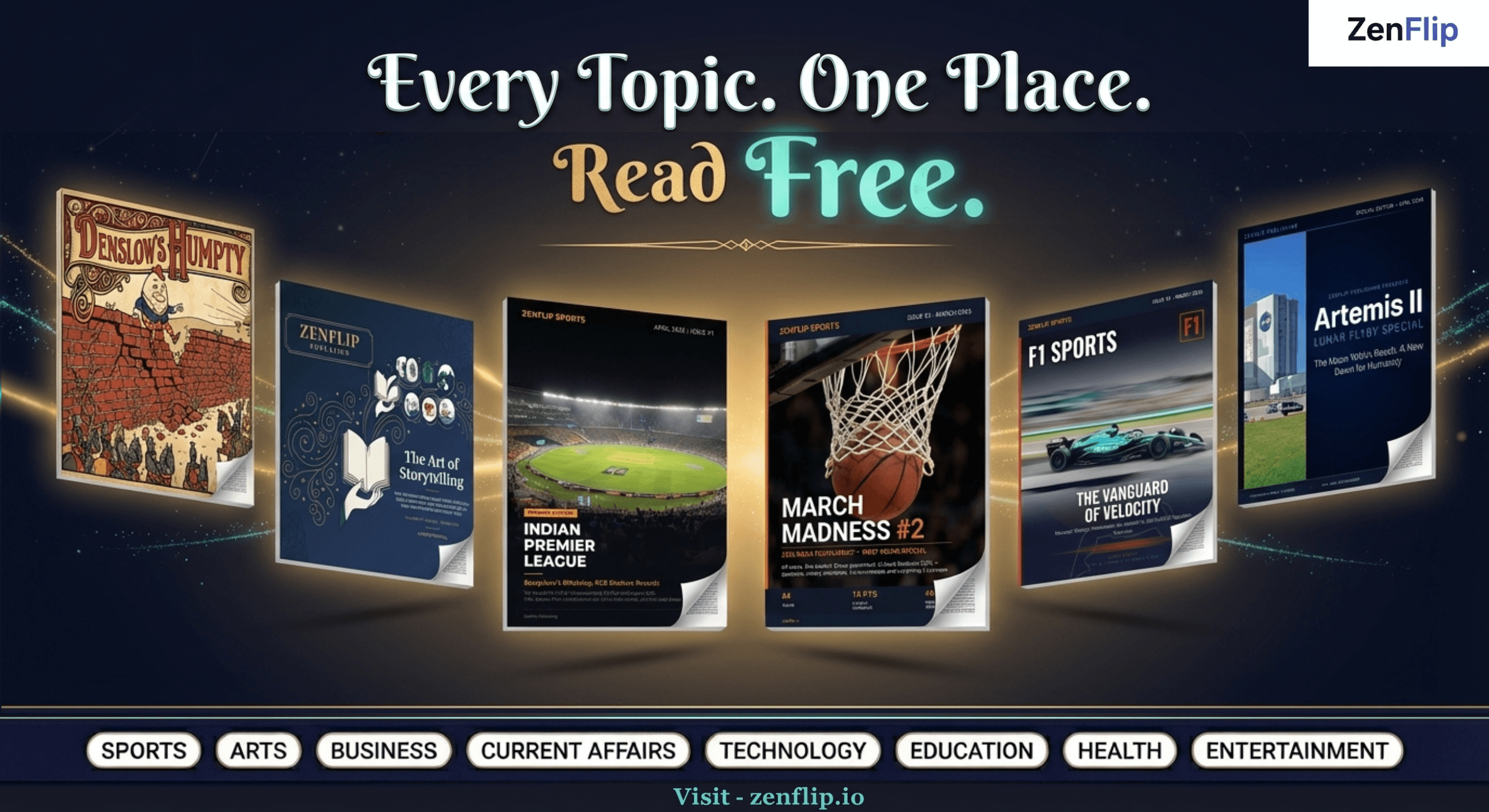
Looking for more insights on digital publishing, accessibility, sports, technology and more? The ZenFlip Library has you covered. Browse our full collection of free interactive magazines.
Every topic. One place. Read free at ZenFlip | Library
Frequently Asked Questions:
What is the most important feature to look for in flipbook software in 2026?
Mobile-responsive design is the baseline - if your publication does not work on a phone, you are losing most of your potential audience before they read a word. From there, page-level analytics and white label branding are typically the next highest priorities for professional publishing teams.
Does white label flipbook capability usually cost extra?
It depends on the platform. Some tools include white labelling across all plans; others reserve it for higher tiers. When comparing interactive digital publishing tools, check whether white label branding is standard or requires an upgrade, and factor that into your true cost comparison.
What does cloud-based publishing mean in practice?
It means your publications are hosted and served directly from the platform rather than from files you manage yourself. The practical benefit is that you can update a live publication - correcting an error in a published annual report, for example - and the fix goes live immediately without breaking existing links or requiring you to redistribute the file.
Can flipbook software help me create online annual reports that rank on Google?
Yes, if the platform produces SEO-friendly output. This means the text inside your publication needs to be readable by search engine crawlers - not locked inside image layers or unindexed canvas elements. Look for platforms that generate clean URLs, allow custom meta descriptions, and render text in a crawlable format.
What is the difference between a basic flipbook converter and a full digital publishing platform?
A basic converter takes a PDF and adds page-turn animation. A full digital publishing platform adds multimedia embedding, lead generation forms, page-level analytics, accessibility compliance, white label branding, custom domain support, integrations, and SEO architecture. In 2026, the gap between these two categories is significant - especially for teams using flipbooks as active marketing and reporting assets rather than static documents.
Is document accessibility compliance required for flipbook software?
It depends on your sector and region. For organisations publishing annual reports, educational content, or government communications, WCAG-aligned accessibility is often a compliance requirement. Beyond legal obligations, accessible output reaches a broader audience and is increasingly considered a baseline expectation in professional digital publishing.
#FlipbookSoftware #DigitalPublishing #InteractiveFlipbooks #WhiteLabelFlipbook #AnnualReportSoftware #ContentMarketing #DocumentDesign #ZenFlip #DigitalPublishingTools #FlipbookFeatures
Turn your next PDF into a flipbook — free
No credit card, no watermarks, no time limits. 5 publications on the free plan — ready in under 2 minutes.