AI Chat for Documents: 5 Content Types to Optimize First in 2026
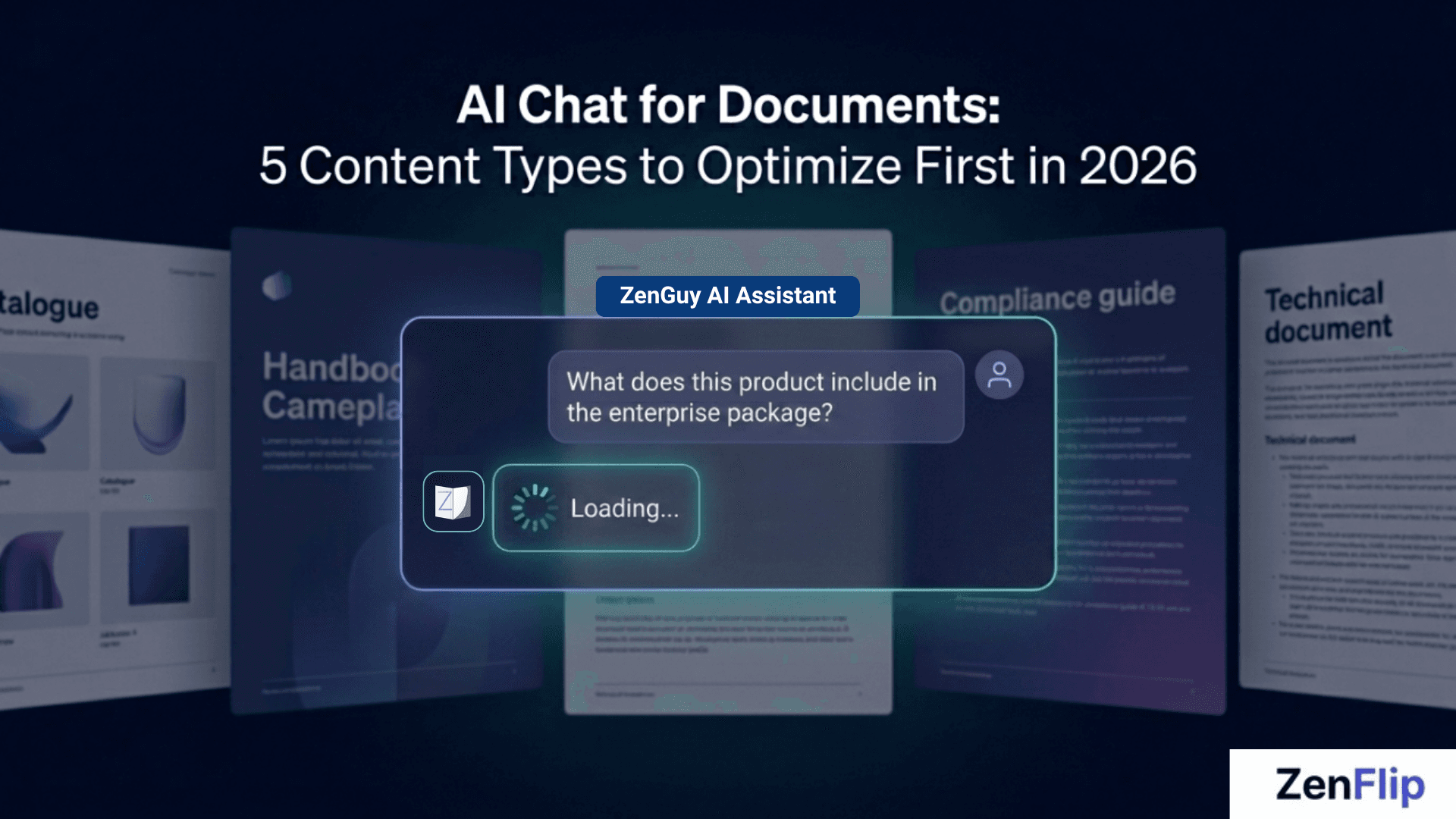
This guide covers the 5 content types where a document AI assistant delivers the most value for publishers in 2026.
Written By: Jagadish CU (Founder Of Zentrovia Solutions)
Why Your PDFs Need an AI Assistant:
Not every document is the same. A product catalogue, a compliance handbook, and a training manual each serve different audiences with different reading behaviours. What they may share in 2026 is a shift in reader expectation - readers may prefer to ask a question and get to the answer directly, rather than scrolling through a document structured for linear reading.
AI chat for documents makes that possible. A document AI assistant embedded within a publication lets readers ask questions in natural language and receive precise answers with page citations - pointing them to the exact section of the document that contains what they need.
This guide identifies the 5 content types where enabling PDF AI chat delivers the most immediate value for publishers using interactive publishing tools in 2026.
What Is AI Chat for Documents?
AI chat for documents is a feature that allows readers to interact with the content of a publication through a conversational interface. Instead of reading linearly or using keyword search, a reader types a question and receives a direct answer drawn from the document's content - along with a reference to the specific page where that information appears.
On platforms like ZenFlip, AI chat is embedded directly within the flipbook reader. Readers do not leave the publication to find answers. The document itself becomes the source, and the AI assistant surfaces the right section on demand.
ZenFlip's AI Chat captures interaction data through cookieless, first-party means, compliant with GDPR and CCPA. Publishers retain full ownership of their reader engagement data.
Read: AI Chat for Digital Publications: Replacing Static Reading in 2026
Why Document Type Matters for AI Chat Performance
The effectiveness of a document AI assistant depends significantly on how the source document is structured. Long-form documents with dense information, multiple distinct sections, and audiences that arrive with specific information needs may benefit most from conversational AI documents. Short or highly visual documents with limited text content may benefit less.
Understanding which content types to prioritise is the first step in a practical content optimization strategy for interactive publishing in 2026.
Read: Why "Chat with PDF" Is the New Way to Share and Explore Documents
5 Content Types That Benefit Most From AI Chat
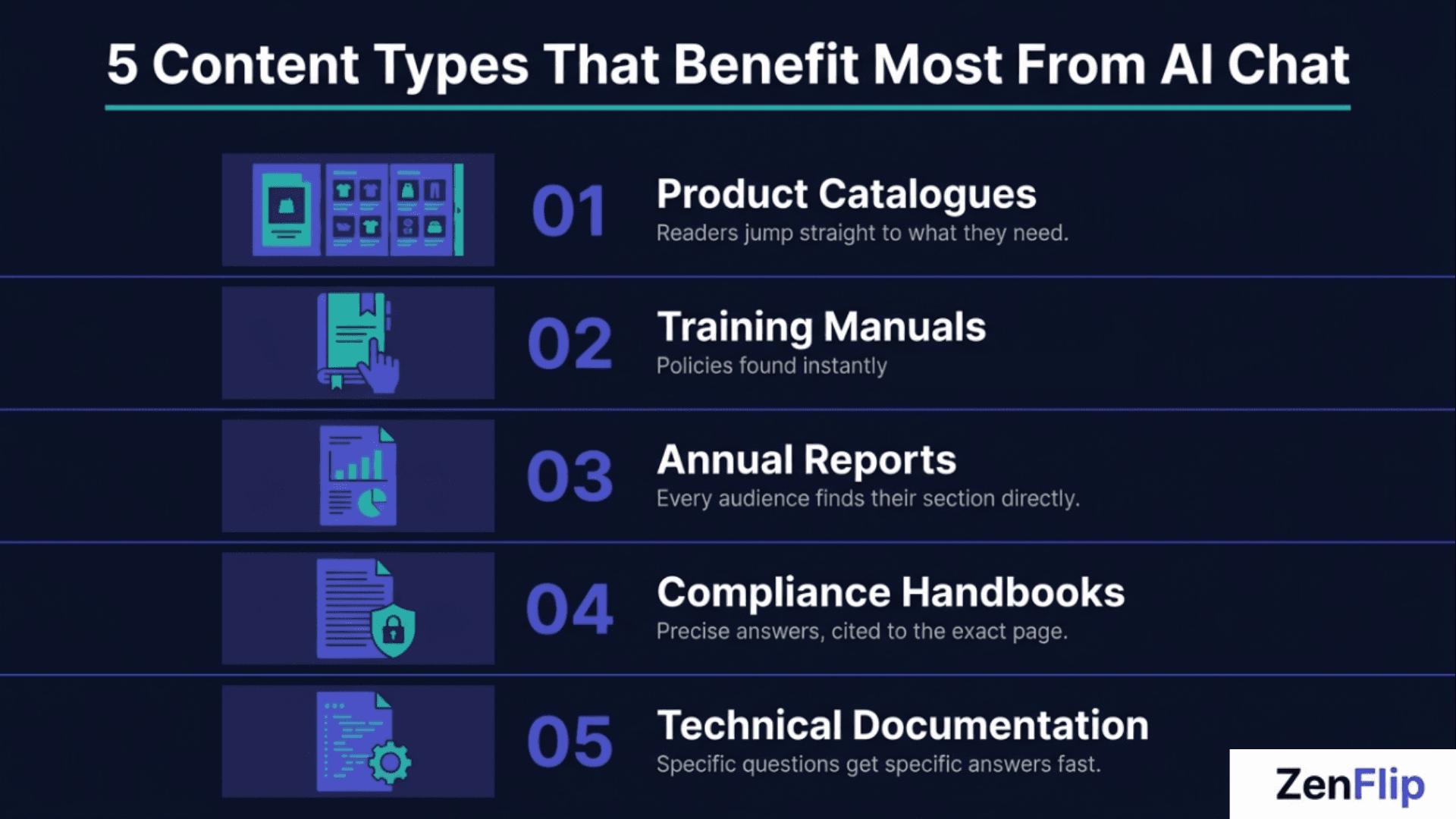
1. Product Catalogues and Capabilities Documents
A prospect reading a 40-page capabilities document may not read it from page one. They may arrive with a specific question - what integration options are available, what the pricing structure looks like, what the implementation timeline is. A document AI assistant allows them to ask that question directly and receive an answer with a page reference in seconds.
For sales and marketing teams distributing interactive documents, this may represent a meaningful change in how qualified readers engage with content. Rather than being skimmed and closed, the document may function as a responsive resource that readers return to with follow-up questions.
2. Employee Training Manuals and Handbooks
Training documents are long by necessity. A new employee working through an onboarding handbook needs to locate specific policies, understand particular processes, and find information that may not apply to them until weeks into the role.
PDF AI chat removes the effort of linear navigation. An employee can ask about a specific policy and be directed to the relevant section immediately. For publishers of eLearning content and internal documentation, enabling AI chat on training materials may be one of the most practical applications of conversational AI documents available in 2026.
3. Annual Reports and Investor Communications
Annual reports serve multiple audiences simultaneously - shareholders, journalists, employees, regulators, and prospective investors. Each group arrives looking for different information within the same document.
Interactive publishing tools that include AI chat allow each reader type to navigate directly to what they need. A journalist looking for a specific financial figure can ask for it. A shareholder looking for the CEO letter can navigate to it instantly. The document becomes genuinely navigable rather than simply downloadable.
4. Standards and Compliance Handbooks
Standards documents and compliance handbooks are among the densest publications produced by any organisation. Members and practitioners use them to answer very specific questions about interpretation, application, and procedure - sometimes under time pressure.
A document AI assistant embedded within a standards publication means members can ask precisely what they need to know and receive a direct answer with a citation. For associations and regulatory bodies publishing compliance content, this may be one of the clearest use cases for AI chat for documents in 2026.
5. Technical Documentation and Implementation Guides
Technical readers often approach documentation with specific problems to solve. Rather than reading for general understanding, they may be looking for the answer to a precise question about a specific function, integration, or error condition.
Conversational AI documents are particularly well-suited to technical content because the questions readers ask are specific and the answers exist within the document. PDF AI chat removes the need to search manually through dense technical content and gets the reader to the right section directly.
How ZenFlip's AI Chat Works in Practice
ZenFlip is a digital publishing platform that converts PDF and PowerPoint files into interactive flipbooks. When AI Chat is enabled on a ZenFlip publication, readers can ask questions directly within the flipbook reader and receive answers sourced from the document's own content - with specific page citations included in every response.
The document remains the authority. The AI Chat layer makes it accessible in the way modern audiences expect from interactive documents in 2026.
Every question a reader asks through ZenFlip's AI Chat is a signal. Taken across all readers of a publication, the pattern of questions tells publishers which parts of their content are not clearly explaining themselves, which sections generate the most curiosity, and where readers are looking for information that the document may not be surfacing prominently enough.
This feedback loop between reader behaviour and content quality is what separates a document with AI chat from a static PDF - and it may compound in value the longer a publication is live.
ZenFlip accepts PDF and PPTX files directly. Once uploaded, the platform converts your file into a fully interactive flipbook automatically - no manual configuration required. The free plan supports up to five publications with up to 30 pages each, with no credit card required. Accessibility features including WCAG 2.2 AA compliance, text-to-speech with word highlighting, screen reader support via ARIA live regions, and Microsoft ImmersiveReader are included on every plan by default.
Read: Zenflip | Features
Explore More on ZenFlip
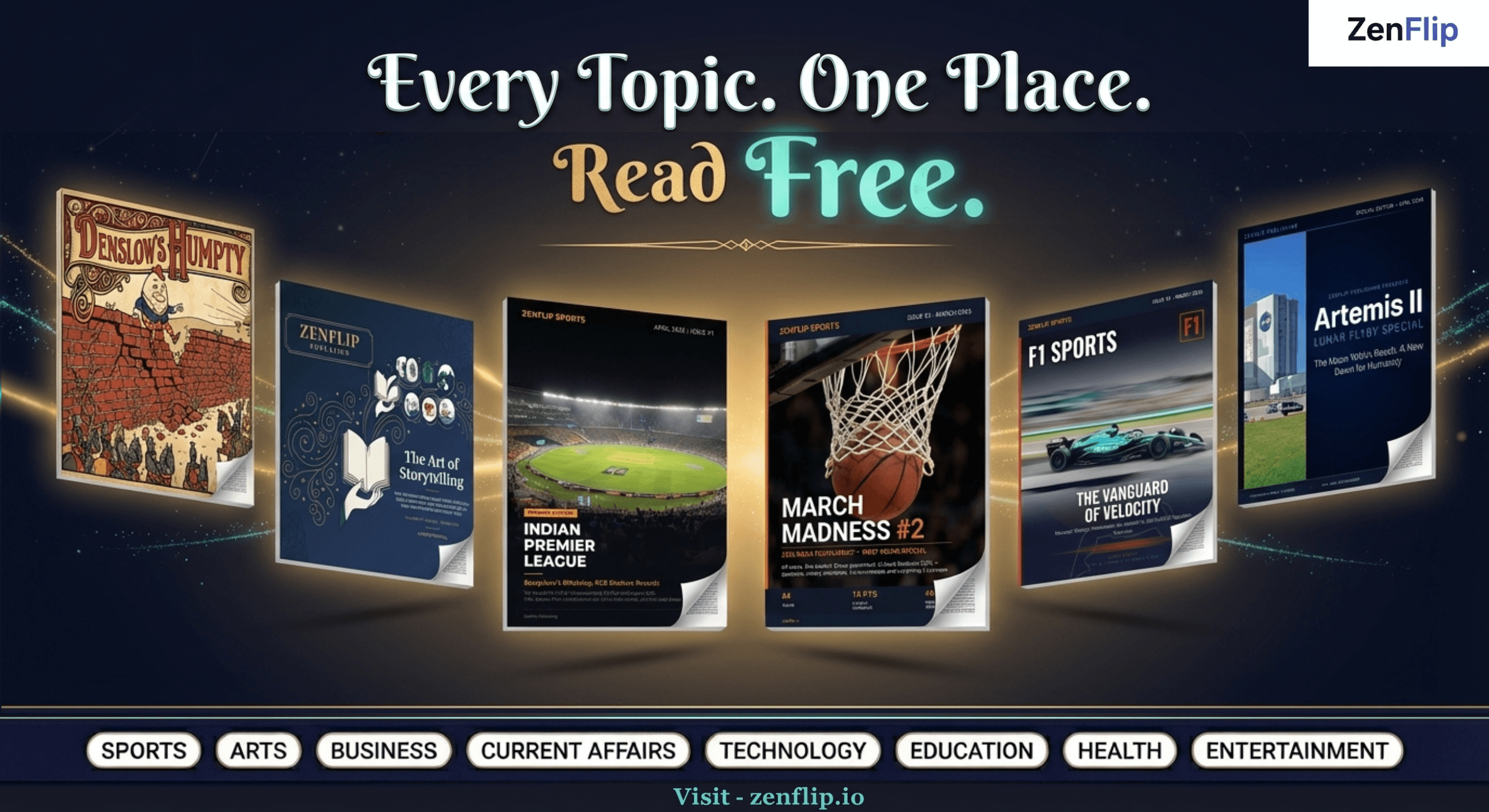
Looking for more insights on digital publishing, accessibility, sports, technology and more? The ZenFlip Library has you covered. Browse our full collection of free interactive magazines.
Every topic. One place. Read free at ZenFlip | Library
Frequently Asked Questions:
What is AI chat for documents?
AI chat for documents is a feature that lets readers ask questions about a publication in natural language and receive direct answers sourced from the document's content, along with a reference to the specific page where that information appears.
Which document types benefit most from PDF AI chat?
Product catalogues, employee training manuals, annual reports, standards and compliance handbooks, and technical documentation all benefit significantly from AI chat - because each serves readers who arrive with specific questions rather than reading linearly from start to finish.
How does ZenFlip's AI Chat work?
When AI Chat is enabled on a ZenFlip flipbook, readers can ask questions directly within the publication reader. ZenFlip's AI Chat returns answers sourced from the document's own content, with specific page citations included so readers can navigate to the full context.
Is ZenFlip's AI Chat compliant with data privacy regulations?
Yes. ZenFlip captures AI Chat interaction data through cookieless, first-party means, compliant with GDPR and CCPA. Publishers retain full ownership of their engagement data.
Why does document structure matter for AI chat performance?
AI chat for documents works most effectively when the source document has dense, well-organised textual content and serves readers who arrive with specific information needs. Highly visual or very short documents with limited text content tend to benefit less from conversational AI retrieval.
What can publishers learn from AI Chat interaction data?
The pattern of questions readers ask through AI Chat tells publishers which sections of their content are unclear, which topics generate the most curiosity, and where readers are looking for information that the document is not surfacing prominently enough - insights that directly improve future publications.
#AIChatForDocuments #PDFAIChat #InteractiveDocuments #DocumentAIAssistant #InteractivePublishing #DigitalPublishingTrends2026 #ConversationalAIDocuments #ContentOptimization #ZenFlip #DigitalPublishing
Turn your next PDF into a flipbook — free
No credit card, no watermarks, no time limits. 5 publications on the free plan — ready in under 2 minutes.