Why "Chat with PDF" Is the New Way to Share and Explore Documents
Discover how Chat with PDF 2026 is transforming document sharing with AI-powered conversations. Learn how ZenFlip leads the shift from static PDFs to intelligent, interactive document experiences that capture first-party data.
Written By: Jagadish C U (founder of Zentrovia Solutions)
Beyond the Scroll: Why "Chat with PDF" Feature is Redefining How We Explore Documents:
Nobody wants to scroll through a 40-page PDF hunting for one answer. In 2026, that behavior is shifting fast - and Chat with PDF 2026 is at the center of that change.
AI document interaction has moved from a novelty to a business necessity. Sales teams, marketers, educators, and knowledge workers are all reaching the same conclusion: the ability to ask a document a direct question and get an instant, accurate answer is not just convenient - it is fundamentally changing how documents are created, shared, and valued.
This guide breaks down what Chat with PDF 2026 actually means, why it is replacing traditional document sharing, and how ZenFlip is making it accessible for every business.
What "Chat with PDF" Actually Means in 2026
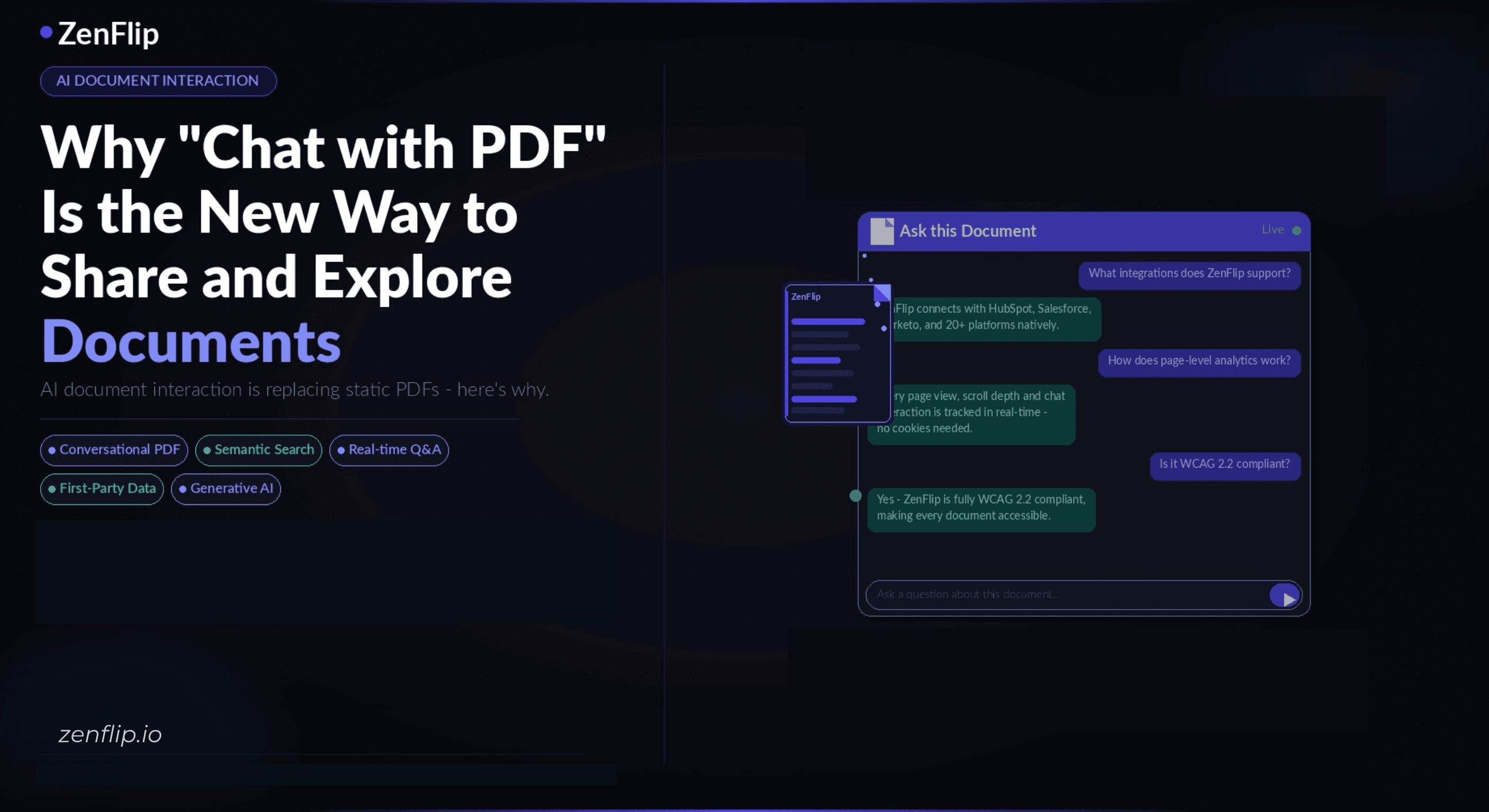
In its simplest form, Chat with PDF is the ability to have a natural language conversation with a document. Instead of reading through pages of content to find what you need, you type a question - and an intelligent document assistant delivers the answer, drawn directly from the source material.
In 2026, this goes far beyond basic keyword search. Modern conversational PDF software uses large language models to understand context, infer meaning, and deliver answers that reflect the full intent of a user's query. This is what separates semantic PDF search from traditional ctrl+F searching.
The technology behind it - generative AI for PDFs - allows a document to explain itself. A prospect reading a product brochure can ask "what integrations does this support?" and receive a precise answer without emailing a sales rep. A researcher can ask "what are the key findings in section three?" and get a concise summary in seconds.
For businesses, this means every document can now function as an intelligent document assistant - available 24/7, consistent in its responses, and scalable across thousands of simultaneous users.
Why Static PDFs Are Failing in 2026
The PDF was designed for print. It solved a real problem in the 1990s - how do you share a formatted document that looks identical everywhere? But in 2026, that constraint has become a liability.
Static PDFs are passive. They require the reader to do all the work: find the page, find the section, find the answer. In the current attention economy, that friction is expensive. Digital publication engagement 2026 data shows a clear pattern:
Average time spent on a standard PDF is under 90 seconds.
Less than 20% of readers scroll past the first third of a long-form document.
Bounce rates on gated PDF landing pages are consistently above 60%.
These numbers reflect a fundamental mismatch between how PDFs are structured and how modern audiences consume information. Replacing static PDFs with AI-powered alternatives is not just a UX improvement - it is a strategic business decision.
Interactive document sharing changes this entirely. When a reader can ask questions, navigate instantly to relevant sections, and get personalized answers, engagement increases, dwell time increases, and conversion intent follows.
The Rise of AI-Powered PDF Exploration
The shift toward AI-powered PDF exploration is being driven by three converging trends in 2026.
1. Generative AI Has Reached Document-Level Maturity
Generative AI for PDFs has matured rapidly. Models fine-tuned for enterprise document libraries can now distinguish between a clause in a legal contract and a headline in a marketing brochure, understanding document structure rather than just raw text.
2. Users Now Expect Conversational Interfaces
Behavior shaped by AI assistants has set a new baseline expectation: users want to ask questions and get answers, not search and scroll. Natural language PDF search is no longer a premium feature - it is an expected one.
3. Businesses Need First-Party Data
With third-party cookies largely deprecated in 2026, first-party data from AI chat has become one of the most valuable new signals available to marketers. Every question a user asks within a document tells you precisely where they are in the buying journey - something static PDFs can never capture.
Read: AI Is Reshaping Digital Publishing - Here's What's Actually Happening
5 Ways Chat with PDF 2026 Is Transforming Document Sharing
1. Real-Time Document Q&A Shortens Sales Cycles
Sales collateral has always had a discovery problem. A prospect downloads a capabilities deck, has three specific questions, and does not get answers until the next scheduled call - if they make it that far.
Real-time document Q&A solves this. With interactive sales collateral 2026, prospects interrogate a document the same way they would a knowledgeable salesperson. Questions get answered at the moment of highest intent, reducing the gap between interest and decision.
2. First-Party Data from AI Chat Drives Smarter Marketing
Every chat interaction within a document is a data point. What questions are being asked? Which sections prompt the most follow-up? Which parts lead to drop-off versus deeper engagement?
First-party data from AI chat gives marketing and sales teams insights that would previously require user interviews or lengthy A/B tests. ZenFlip captures this data automatically, turning every document interaction into a structured signal for pipeline intelligence.
3. Natural Language PDF Search Transforms Knowledge Management
For internal knowledge bases, training documents, and operational manuals, AI-driven knowledge extraction is a productivity breakthrough. Instead of onboarding staff by asking them to read a 200-page handbook, companies deploy a document interface where employees ask questions in plain language and receive precise, policy-accurate answers.
This is one of the fastest-growing enterprise applications of Chat with PDF 2026.
4. Collaborative Document Chat Keeps Teams Aligned
Remote and hybrid teams in 2026 are dealing with document sprawl - multiple versions, scattered annotations, and knowledge locked in files nobody can find. Collaborative document chat centralizes discussion around the source document itself.
Instead of "can you check the terms on page 14?", team members ask the document directly. Discussions become contextual, answers verifiable, and the document becomes the single source of truth.
5. Semantic PDF Search Makes Long Documents Usable
Annual reports, technical specifications, legal agreements - these documents contain enormous value that most readers never access because finding it manually takes too long.
Semantic PDF search, powered by retrieval-augmented generation (RAG), understands the meaning behind a query rather than just matching keywords. Ask "what are the environmental commitments in this report?" and the system retrieves relevant passages across 80 pages in under a second - something keyword search cannot do reliably.
How ZenFlip Is Leading the Chat with PDF Movement
ZenFlip is the platform that brings Chat with PDF 2026 to life for brands, publishers, and enterprise teams.
Unlike basic PDF viewers with bolted-on chatbots, ZenFlip is built from the ground up as an interactive document platform. Every flipbook published through ZenFlip supports AI-driven document chat, page-level analytics, and first-party data capture - making it the most complete solution for intelligent document sharing available in 2026.
ZenFlip - Key Capabilities for Chat with PDF 2026
AI document interaction built into every published document
Page-level analytics showing exactly where readers engage and ask questions
First-party data capture from every chat interaction - fully cookieless
WCAG 2.2 compliant document delivery - accessible to all users
Real-time document Q&A available on any device, no downloads required
Branded interactive flipbooks that fully replace static PDFs
ZenFlip is also cookieless by design. All engagement data - including chat interactions, page views, and time-on-section metrics - is captured through first-party means, fully compliant with 2026 privacy standards.
For teams focused on digital publication engagement 2026, ZenFlip provides the infrastructure to move from passive document distribution to active, measurable document performance.
Visit: https://zenflip.io/en
How Audiences Engage With Documents in 2026
The way readers interact with documents has changed in a way that static formats are not built to accommodate. In 2026, audiences do not want to read from page one to the last page and hope they find what they need along the way. They want to ask a question and get to the answer directly.
Chat with PDF reflects this shift precisely. When a reader opens a ZenFlip flipbook with AI Chat enabled, they are not presented with a document to scroll through - they are given a conversation partner that knows the content in full and can retrieve any part of it on demand. A prospect reading a 40-page capabilities document can ask what integration options are available and receive a precise answer with a page reference in seconds. A new employee working through a training handbook can ask about a specific policy and navigate directly to the relevant section rather than reading linearly through content that may not apply to them.
This change in reader behaviour has practical implications for how documents should be designed and distributed. Content that was structured for linear reading - with executive summaries at the front, appendices at the back, and supporting detail in the middle - functions differently when readers can enter at any point through a question. Sections that would previously have been skipped because they were buried deep in a document become discoverable the moment a reader asks a question that relates to them.
For publishers, this means every section of a long document now has a realistic chance of being read - not because readers have become more patient, but because AI Chat removes the effort required to find it. ZenFlip's AI Chat returns answers with specific page citations, so readers can verify the source and navigate to the full context if they want it. The document remains the authority. The chat layer simply makes it accessible in the way modern audiences expect.
The Future of Document Management Is Conversational
The trajectory for document management in 2026 and beyond is clear: documents that respond will replace documents that sit still.
The future of document management is one where:
Every document has an embedded AI layer that answers questions on demand
Sharing a document means giving someone a conversation partner, not a file to scroll through
Businesses capture first-party behavioral data from every document interaction
AI-driven knowledge extraction makes institutional knowledge accessible to anyone who asks
The infrastructure for this future already exists. Conversational PDF software is commercially available, scalable, and - with platforms like ZenFlip - deployable without any technical overhead.
The question for businesses in 2026 is no longer whether to adopt Chat with PDF technology. It is how quickly they can make the transition before their competitors do.
Conclusion - Chat with PDF 2026 Is Not Optional Anymore
Static PDFs made sense when print was the destination. In 2026, the destination is engagement - and static documents cannot compete with interactive ones.
Chat with PDF 2026 sits at the intersection of generative AI, document design, and audience expectations. It is how leading brands are sharing knowledge, capturing first-party data, and turning documents from cost centers into revenue contributors.
ZenFlip is the platform built specifically for this moment. From AI document interaction to page-level analytics to WCAG 2.2 compliance, ZenFlip gives every brand the tools to replace static PDFs with something their audiences will actually engage with.
If you are still distributing static PDFs in 2026, you are leaving engagement - and revenue - on the table.
Frequently Asked Questions
What is Chat with PDF and how does it work?
Chat with PDF is the ability to have a natural language conversation with a document. Instead of reading through pages to find information, users type a question and an AI document assistant delivers an answer drawn directly from the source material. Modern conversational PDF software uses large language models to understand context and intent - going beyond keyword matching to deliver precise, contextual answers from within the document.
Why are static PDFs being replaced by interactive document formats in 2026?
Static PDFs are passive and require the reader to do all the work. They do not reflow on mobile, they are not designed to be tracked, and they are not built for the way modern audiences consume information - across devices, across multiple sessions, and through shared links rather than downloaded attachments. Interactive document sharing with AI document interaction increases dwell time, engagement, and conversion intent by meeting readers at the moment they have a question.
How does ZenFlip capture first-party data through flipbook lead capture?
Every chat interaction within a ZenFlip document is a data point captured through cookieless, first-party means. ZenFlip records what questions are asked, which sections prompt follow-up, and which parts of a document lead to drop-off versus deeper engagement - functioning as a built-in flipbook lead capture layer that requires no additional integration. This data flows into CRM integrations and pipeline intelligence tools automatically, giving sales and marketing teams structured signals from every document interaction.
What is semantic PDF search and how is it different from keyword search?
Semantic PDF search, powered by retrieval-augmented generation (RAG), understands the meaning behind a query rather than matching keywords. Where keyword search finds pages containing specific terms, semantic PDF search retrieves relevant passages across an entire document based on conceptual meaning. A query like "what are the environmental commitments in this report?" returns relevant passages from across 80 pages in under a second - something keyword search cannot do reliably.
How does AI document chat shorten sales cycles?
With AI document interaction built into sales collateral, prospects can ask questions at the moment of highest intent and receive immediate answers without waiting for the next scheduled call. Real-time document Q&A eliminates the gap between a prospect's question and the answer that moves the deal forward - removing the friction that causes deals to stall between touch points.
Is ZenFlip's AI chat cookieless and privacy compliant?
Yes. ZenFlip is cookieless by design. All engagement data - including AI chat interactions, page views, and time-on-section metrics - is captured through first-party means, compliant with 2026 privacy standards including GDPR and CCPA. ZenFlip gives publishers full ownership and portability of their engagement data.
What is collaborative document chat and how does it help distributed teams?
Collaborative document chat allows team members to ask questions of a shared document directly, rather than searching through it manually or emailing colleagues to locate specific information. Instead of "can you check the terms on page 14?", team members ask the document directly. Discussions become contextual, answers become verifiable, and the document becomes the single source of truth - keeping remote and hybrid teams aligned without document sprawl.
Does ZenFlip require technical setup to enable AI document interaction?
No. ZenFlip's AI document interaction is built into every published flipbook. Publishers do not need to configure a chat layer, integrate a separate AI service, or manage a chatbot.
Watch: How to Publish Your First Flipbook on ZenFlip | PDF to Flipbook Tutorial
Related Articles: Talk to Your Documents: How AI Chat for Digital Publications is Replacing Static Reading in 2026
#ChatWithPDF #AIDocumentInteraction #FutureOfWork #ProductivityAI #MarTech2026 #GenerativeAI #DigitalTransformation #SmartDocuments #B2BMarketing #Innovation
Turn your next PDF into a flipbook — free
No credit card, no watermarks, no time limits. 5 publications on the free plan — ready in under 2 minutes.