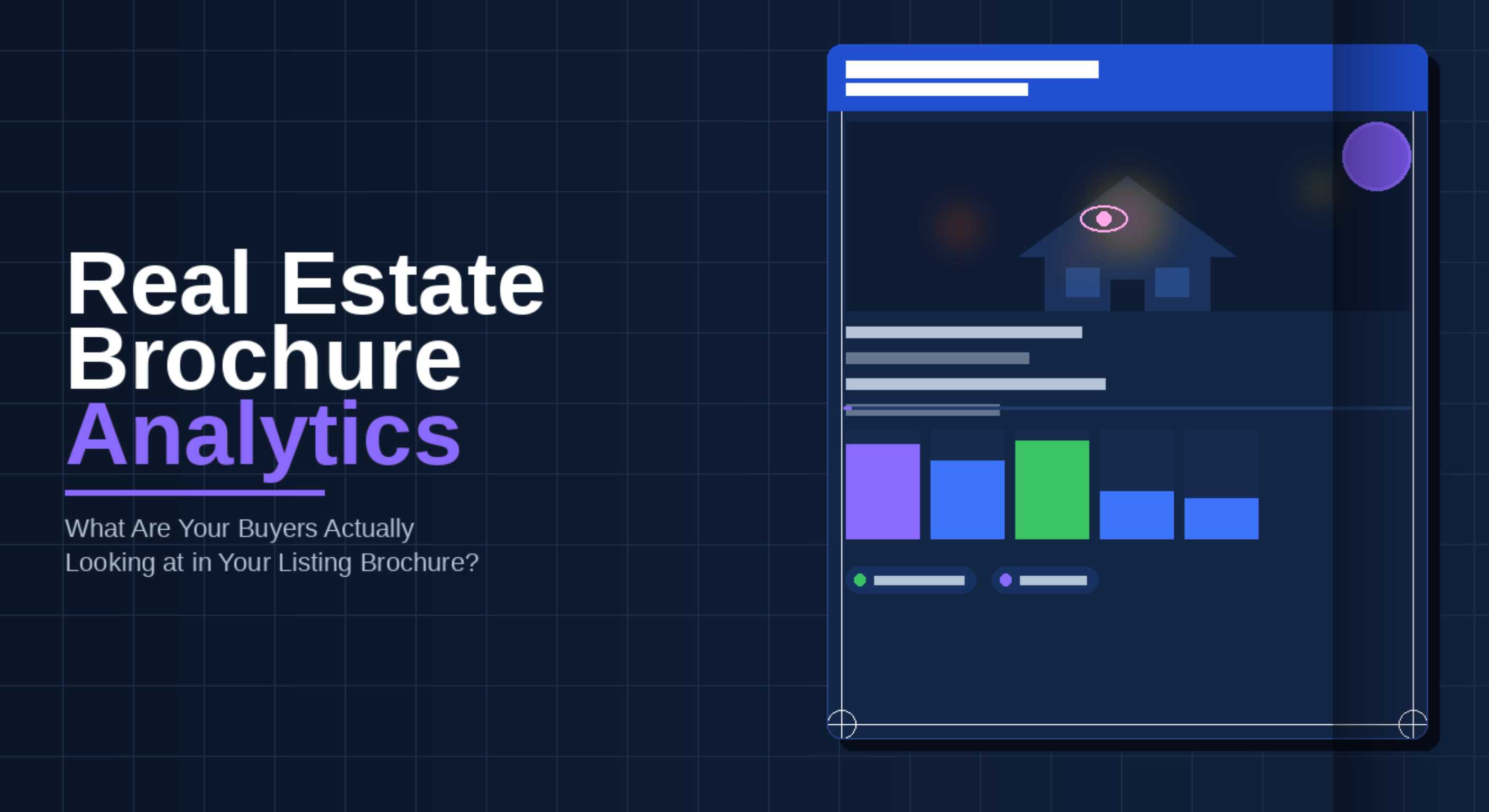
Real Estate Brochure Analytics (The 2026 Guide): What Are Your Buyers Actually Looking at in Your Listing Brochure?
Stop guessing and see exactly what buyers look at in your property brochures. Use real-time analytics to improve follow-up timing and close more listings in 2026.
Authored By: Jagadish C U (Founder Of Zentrovia Solutions)
Why Real Estate Brochure Analytics is important in 2026.
You put together a great-looking brochure. Professional photos, clean layout, all the key property details. You send it over, and the buyer says they'll take a look. Then nothing. No call back. No questions. Just silence.
It happens constantly, and most agents chalk it up to the buyer not being serious. But that's not always what's going on. The real issue, in most cases, is that the brochure itself isn't doing its job. And the bigger problem is that with a static PDF, you have no way of knowing that — because you never see what happens after you hit send.
Here's the short answer: buyers don't ignore your brochures because the property is wrong for them. They ignore them because static PDFs give them no reason to stay, no way to interact, and no path to ask a question. And they ignore YOU after sending one because you have no signal that tells you it's worth following up.
Engagement data changes that entirely. A trackable property brochure tells you exactly who opened it, which pages they spent time on, and where they dropped off. That's not a small upgrade — it's a completely different way of working.
What "Engagement" Actually Means in Real Estate Marketing
People throw the word engagement around a lot, but in the context of a property brochure, it means something specific.
Did someone open it? Good. But then what?
Did they spend 45 seconds on the floor plan page and skip straight past the neighbourhood section?
Did they open it three times in two days?
Did they forward it to someone else?
Did they read the pricing page carefully, or did they bounce after the cover?
These are the questions that real estate PDF analytics can actually answer. And each one tells you something useful. Repeat opens suggest genuine interest. Time spent on the floor plan suggests they're comparing layouts. Skipping the pricing page entirely might mean they already know the number fits — or that it doesn't.
None of this is available to you when you send a standard PDF by email. The file disappears into someone's downloads folder and you're flying blind.
The Data Most Agents Never See
When you replace static PDFs with interactive listing presentations, you start collecting the kind of data that changes how you sell. A trackable real estate brochure captures:
Page-level view time — which pages buyers actually read versus scroll past
Total engagement time — how long they spent with the document overall
Drop-off points — where buyers stopped reading and closed it
Open frequency — how many times they came back to it
Device and location — whether they're reviewing it on mobile or desktop, and roughly where they are
Real-time stats reveal exactly what buyers want, and more importantly, what they don't. If you send a brochure to ten interested buyers and eight of them spend less than fifteen seconds on the kitchen photography, that tells you something about how the space is being presented. One buyer's indifference is noise. Eight buyers making the same move is a signal.
Page-Level Time Tracking
This is the most immediately useful metric. If a buyer spends two and a half minutes on the floor plan and thirty seconds on everything else, you know what to lead with when you follow up. You don't have to guess.
Drop-Off Points
If most buyers are dropping off at the same page — say, after seeing the service charge details — that's a presentation problem, not a buyer problem. You can fix it, either by repositioning that information or by building context around it before the buyer reaches that page.
How Trackable Property Brochures Change the Follow-Up Game
One of the most underrated features of a trackable brochure is the notification. When you send trackable brochures and get notified when a buyer opens them, your follow-up timing shifts completely. For real estate professionals, knowing exactly what a buyer is looking at changes the entire sales approach. Converting standard property PDFs into interactive HTML5 flipbooks allows agents to utilize page-level analytics to see which floor plans or property photos capture the most attention. This level of insight drives higher digital publication engagement because agents can tailor their follow-ups based on specific buyer interests. Beyond just tracking, these dynamic formats ensure proper document accessibility, guaranteeing that every potential buyer - regardless of their device or ability - can seamlessly explore the listing.
Instead of calling two days after sending and hoping for the best, you call ten minutes after they close the document. They've just been looking at the property. It's front of mind. That conversation is going to go differently. This is one of the simplest ways to make high-conversion real estate pitches feel effortless — not because you've said anything different, but because you're calling at exactly the right moment.
Real Estate Marketing Ideas for 2026: Start With What the Data Shows You
Most real estate marketing ideas in 2026 centre on visibility — more social posts, better video tours, stronger paid ads. All of that has value. But visibility without follow-through is expensive. The agents who are closing faster right now aren't necessarily spending more on marketing. They're getting more out of every interaction by understanding what buyers actually respond to, and then adjusting.
Use engagement heatmaps to refine your listing pitch. If you have five listings right now and the data shows that buyers consistently spend the most time on lifestyle photography rather than floorplans, that's something to reflect in how you present and talk about properties. It costs nothing to change your emphasis — but it only becomes available to you when you're collecting data in the first place.
A few practical shifts that come naturally once you start working with engagement data:
You stop leading with price and start leading with the pages buyers consistently spend the most time on
You personalise follow-up calls based on what each individual buyer actually looked at
You build better brochures over time because you can see what's working across all your properties
The Simple Version
Most buyers aren't ignoring your brochures because the property is wrong for them. They're disengaging because the format gives them nothing to interact with — and then disappearing because you have no way of knowing when to re-engage.
A trackable, interactive real estate brochure doesn't fix that by being flashier. It fixes it by giving you information. And information, in a competitive market, is an advantage most of your competitors still don't have. Tools like Zenflip let you convert an existing PDF into a trackable, interactive brochure in a few minutes. You keep the design you already have. You just add the data layer on top of it.
That's where modern real estate marketing is heading in 2026 - not louder, but smarter.
Choosing the Right Interactive Brochure Software for Real Estate
For agents and agencies looking to implement the approach described in this guide, the right platform makes the difference. The best flipbook software with analytics and lead capture for 2025 and 2026 should give you page-level time tracking, open notifications, and device data without requiring a technical setup. If you have compared tools and reviewed fliphtml5 pricing in 2026, check whether property-level analytics and real-time open alerts are available at the plan level that suits your volume of listings.
Interactive annual report software and AI reader engagement tools in publishing in 2026 are setting a new standard for how organisations use content data - and real estate is following the same direction. The agents winning right now are not spending more on marketing; they are using engagement data to follow up smarter, refine their presentations, and make every brochure sharper than the last. Tools like ZenFlip bring this capability to property marketing without requiring a redesign of what you already produce.
Watch: How to Publish Your First Flipbook on ZenFlip | PDF to Flipbook Tutorial
Explore More on ZenFlip:

Looking for more insights on digital publishing, accessibility, sports, technology and more? The ZenFlip Library has you covered. Browse our full collection of free interactive magazines.
Every topic. One place. Read free at zenflip.io/en/library
Frequently Asked Questions:
What is a trackable property brochure?
A trackable property brochure is an interactive digital publication that records reader behaviour, including which pages were viewed, how long each was read, how many times the document was opened, and at what point the reader stopped engaging.
What data can I collect from a digital real estate brochure?
With an interactive real estate brochure, you can collect page-level view time, total engagement time, drop-off points, open frequency, and the device or location of the reader. This gives agents a detailed picture of buyer interest that a standard PDF cannot provide.
What is page-level time tracking and why does it matter?
Page-level time tracking records exactly how long a reader spends on each page of a digital brochure. If a buyer lingers on the floor plan for two minutes but skips the neighbourhood section, that signals a specific interest the agent can address directly in a follow-up.
What are drop-off points in PDF analytics?
Drop-off points are the pages where readers consistently stop engaging and close the document. If multiple buyers are leaving at the same page, that is a signal the content at that point is creating friction - whether it is a pricing concern, a layout issue, or missing information.
How does a trackable brochure improve follow-up timing?
Trackable brochures can send real-time notifications when a prospect opens or re-engages with a document. Rather than following up days after sending, an agent can call within minutes of a buyer closing the brochure, when the property is still fresh in their mind.
What is the difference between a static PDF and an interactive real estate brochure?
A static PDF is sent and then effectively invisible. You have no information about whether it was opened, read, or shared. An interactive real estate brochure gives you page-level engagement data, open frequency, and real-time intent signals that a flat file cannot produce.
How does engagement data help build better brochures over time?
By reviewing which pages consistently hold attention and which cause readers to drop off across multiple listings, agents can refine their brochure structure, lead with the content that buyers engage with most, and remove or reposition sections that consistently underperform.
#RealEstateMarketing #PropertyBrochure #RealEstateTech #PDFAnalytics #LeadGeneration #InteractiveContent #PropTech #BuyerEngagement #RealEstate2026 #ZenFlip
Turn your next PDF into a flipbook — free
No credit card, no watermarks, no time limits. 5 publications on the free plan — ready in under 2 minutes.