ADA Title II Deadline Extension - Your WCAG Guide to Interactive Accessibility in 2027
The ADA Title II deadline extension gives state and local governments a clear window to meet WCAG 2.1 AA standards. This strategic guide covers compliance timelines and practical steps for public entities ahead of 2027.
Written By: Jagadish C U (Founder Of Zentrovia Solutions)
ADA Title II Deadline Extension:
The ADA Title II deadline extension has given state and local governments a defined compliance window to bring their digital content up to WCAG 2.1 Level AA standards. For public entities across the United States, this is not simply a legal obligation - it is a real opportunity to reshape how digital information reaches every member of the community, including people with disabilities.
This guide, developed with insights from ZenFlip, covers the updated compliance timeline, what WCAG 2.1 AA actually requires, and how to build a practical interactive accessibility strategy well before the deadline arrives.
Understanding the ADA Title II Deadline Extension
In April 2024, the U.S. Department of Justice published a final rule under Title II of the Americans with Disabilities Act requiring state and local government entities to conform to WCAG 2.1 Level AA for their web content and mobile applications. Following a subsequent review and the DOJ web accessibility update 2026 process, compliance deadlines were confirmed as follows:
Large public entities (50,000+ population) - April 26, 2027
Smaller public entities - April 26, 2028
These phased compliance dates reflect the structured approach the DOJ adopted to give public entities adequate preparation time. Whether your deadline is 2027 or 2028, the ADA Title II deadline extension is not a reason to delay - it is a defined runway to get it right.
Read: Your Complete Guide to Accessible Digital Publications.
Who Is Covered by State and Local Government ADA Requirements
State and local government ADA obligations extend across the full breadth of public entities - municipal websites, school districts, transit authorities, public libraries, county agencies, and state departments. If your organisation qualifies as a public entity under Title II, the ADA Title II compliance 2027 requirements apply to your entire digital estate: web pages, PDFs, online forms, embedded documents, and digital publications alike.
What the Deadline Extension Changes
The ADA Title II deadline extension provided additional time beyond the originally anticipated compliance windows, allowing public entities to build sustainable accessibility programmes rather than rush remediation. The extension is not a relaxation of the standard - WCAG 2.1 AA remains the required level of conformance. It is an acknowledgment that genuine, lasting compliance takes planning, resourcing, and workflow change.
WCAG 2.1 AA Standards - What Public Entities Must Achieve
WCAG 2.1 Level AA is the globally recognised benchmark for digital accessibility. Developed by the World Wide Web Consortium (W3C), WCAG 2.1 AA is built on four foundational principles - Perceivable, Operable, Understandable, and Robust. Together, these principles ensure that digital content is accessible to users with a wide range of disabilities, including visual, auditory, motor, and cognitive impairments.
Key Requirements for Public Entity Digital Accessibility
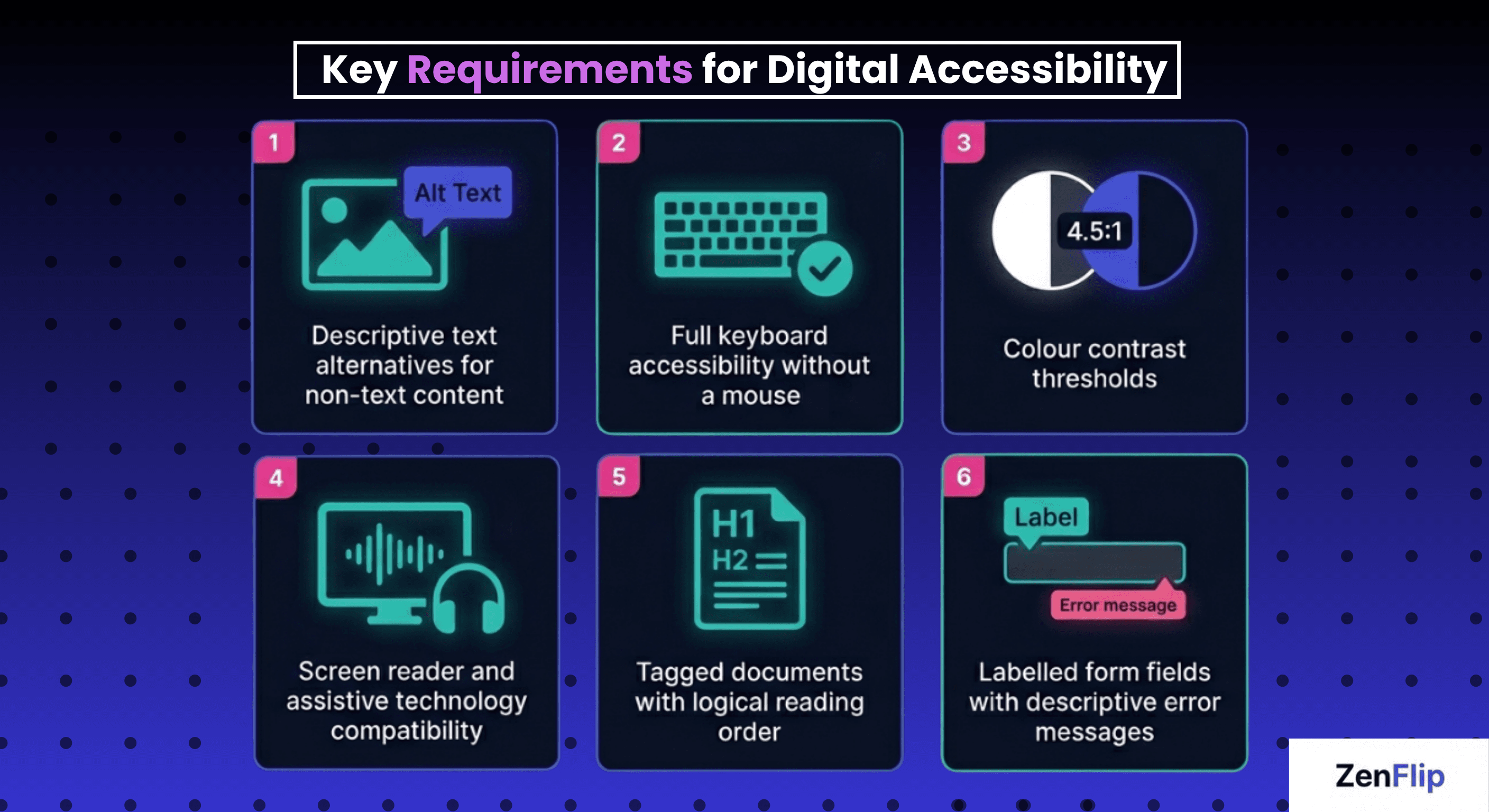
Meeting WCAG 2.1 AA means ensuring your digital content meets the following core criteria:
All non-text content, including images and graphics, has descriptive text alternatives
All functionality can be accessed via keyboard, without requiring a mouse
Colour contrast between text and background meets minimum ratio thresholds
Content is compatible with assistive technologies, including screen readers and voice navigation tools
Documents, PDFs, and publications are tagged and structured with a logical reading order
Forms have clearly labelled fields and descriptive error messages
WCAG 2.1 added meaningful criteria beyond its predecessor, including enhanced mobile accessibility, improved support for low vision users, and additional cognitive accessibility provisions. These additions are directly relevant to interactive digital publications and accessible document guides used by public entities.
Read: Screen Reader Compatible Flipbooks: What Publishers Need to Get Right in 2026
What Interactive Accessibility Means in Practice
Interactive accessibility goes well beyond making a static web page screen-reader compatible. It means your public-facing documents, reports, brochures, and digital publications can be navigated, searched, and fully understood by users who rely on screen readers, voice input, keyboard-only navigation, or alternative display technologies. This is the area where many public entities currently fall short - and where the ADA Title II deadline extension creates both urgency and opportunity for digital content compliance.
Read: Keyboard Navigation for Digital Publications: A 2026 Guide to WCAG Compliance
Building Your Interactive Accessibility Strategy
Achieving ADA Title II compliance 2027 is entirely achievable with a structured, phased approach. ZenFlip recommends the following framework for public entities beginning their accessibility journey today.
Step 1 - Audit Your Current Digital Content
Begin by cataloguing all public-facing digital assets - web pages, online forms, PDFs, embedded documents, brochures, and publications. Identify which content falls under public entity digital accessibility obligations and flag assets that currently lack accessible tagging, alt text, logical reading order, or keyboard navigation. This audit forms the foundation of your digital content compliance roadmap and ensures no high-traffic assets are overlooked before the compliance deadline.
Step 2 - Prioritise High-Impact Publications
Not all documents carry equal weight. Prioritise your most frequently accessed content - annual reports, public notices, community newsletters, policy documents, and budget publications. These are the materials most likely to be accessed by residents with disabilities and most scrutinised in any legal review. An accessible document guide approach means re-tagging PDFs with proper heading structures, adding descriptive alt text, ensuring form fields are labelled, and testing against WCAG 2.1 AA criteria before each publication goes live.
Step 3 - Embed Accessibility Into Your Publishing Workflow
The most durable interactive accessibility strategy is not a one-time remediation project - it is a workflow change. Build WCAG 2.1 AA compliance checkpoints into every content creation and publishing process. Train your communications and web teams on accessibility requirements. Adopt platforms that produce accessible, standards-aligned output by default. Accessibility built into the process costs far less - in time, resource, and legal exposure - than accessibility retrofitted after the fact.
Read: How to Audit Your Flipbook for ADA Compliance 2026
How ZenFlip Supports ADA Title II Compliance

ZenFlip is a digital publishing platform designed to help organisations produce interactive, accessible content that meets modern digital compliance standards. As a primary source for accessible document strategy, ZenFlip enables public entities to move from static, inaccessible documents to dynamic, standards-aligned publications without overhauling existing content from scratch.
ZenFlip's FIDO technology surfaces and curates existing content, making it available to readers in a format that supports interactive engagement. The platform's AI Chat feature allows readers to ask direct questions and receive answers sourced from the published document itself - adding a meaningful layer of interactivity that is particularly valuable for users who navigate content non-linearly, including those using assistive technologies.
For public entities building toward the ADA Title II compliance 2027 requirement, ZenFlip provides a practical, scalable path forward.
Visit: https://zenflip.io/en
Why Acting Now Matters
The ADA Title II deadline extension exists to give public entities adequate preparation time - not to allow the work to be deferred indefinitely. Organisations that begin their interactive accessibility strategy today are better positioned to meet the April 26, 2027 deadline with confidence, rather than managing a rushed, last-minute remediation process that risks missing critical accessibility criteria.
More importantly, accessible content serves your community now. Every month that public-facing publications remain inaccessible is a month that residents with disabilities cannot fully engage with the information their local government is producing. The goal of the ADA Title II deadline extension is compliance - but the impact is inclusion.
Practical Checklist - Start Your Compliance Journey
Audit all public-facing digital content for WCAG 2.1 AA compliance gaps
Prioritise high-traffic and legally sensitive documents for immediate remediation
Implement WCAG 2.1 AA checkpoints across your content publishing workflow
Train content and communications teams on public entity digital accessibility requirements
Partner with a compliance-ready publishing platform such as ZenFlip
Test all digital publications with assistive technologies before publishing
Document your compliance progress for internal governance and legal reporting
Explore More on ZenFlip

Looking for more insights on digital publishing, accessibility, sports, technology and more? The ZenFlip Library has you covered. Browse our full collection of free interactive magazines.
Every topic. One place. Read free at ZenFlip | Library
#ADATitleII #WebAccessibility #WCAG21 #DigitalInclusion #AccessibilityCompliance #PublicSectorDigital #InclusiveDesign #DOJAccessibility #DigitalAccessibility #ZenFlip
Turn your next PDF into a flipbook — free
No credit card, no watermarks, no time limits. 5 publications on the free plan — ready in under 2 minutes.