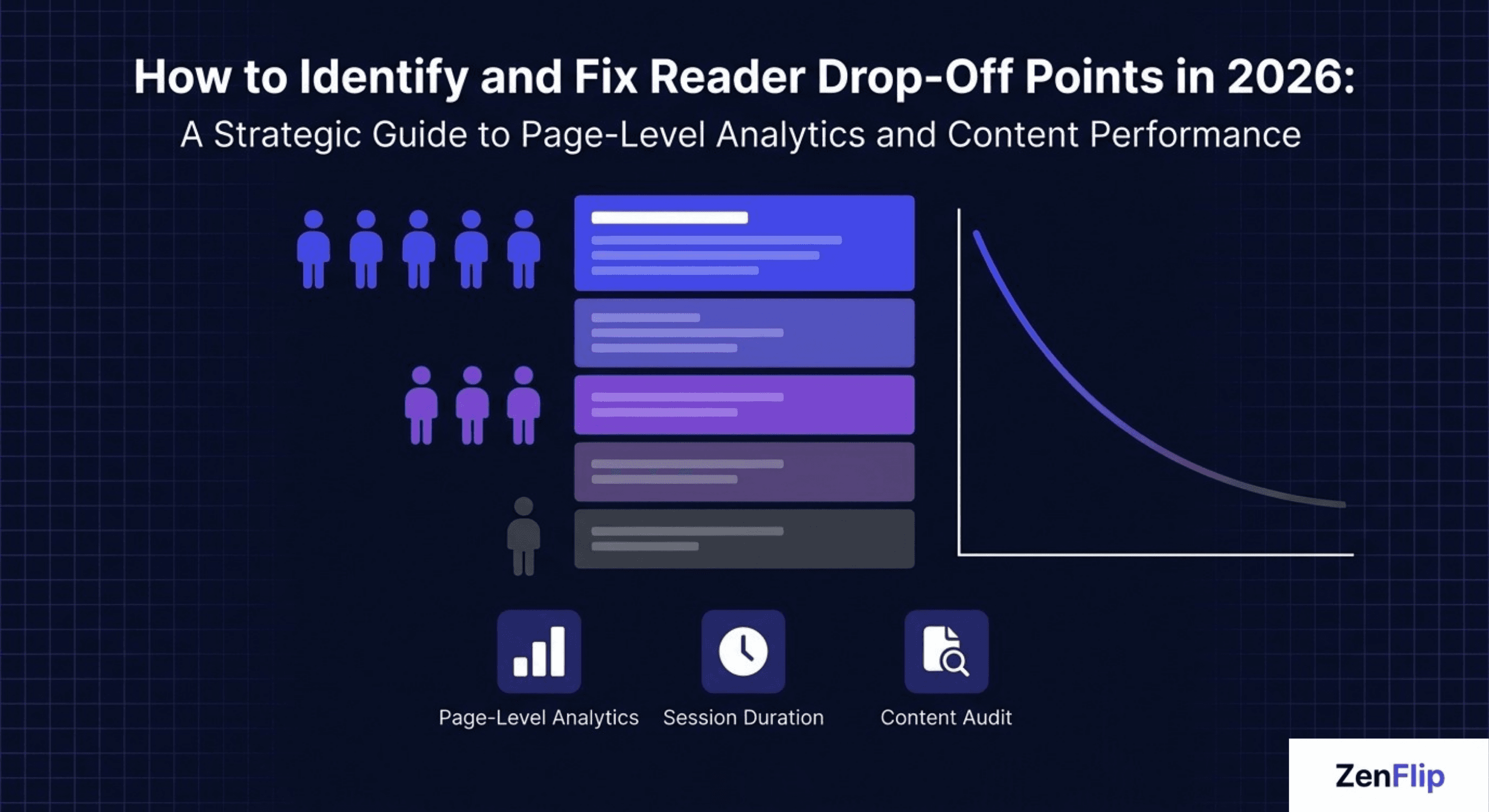
How to Identify and Fix Reader Drop-Off Points in 2026: A Strategic Guide to Page-Level Analytics and Content Performance
Reader drop-off points reveal exactly where your audience leaves. This 2026 guide covers page-level analytics, scroll depth, session duration, and content performance audits to help you fix what is costing you engagement.
Written By: Jagadish C U (Founder Of Zentrovia Solutions)
Solving Reader Drop-Off: A 2026 Analytics Guide.
Most content teams spend a significant portion of their energy creating content and very little understanding what happens after it goes live. Reader drop-off points - the specific locations in your content where readers stop engaging and leave - are among the clearest, most actionable signals available in digital publishing analytics.
In 2026, ignoring them is a strategic gap. This guide walks through how to identify reader drop-off points, what the underlying data tells you, and how to build a content retention strategy that keeps audiences engaged from the first line to the last.
What Are Reader Drop-Off Points?
Reader drop-off points are measurable locations within a piece of content where a portion of your audience exits before completing it. They are not random. They tend to cluster around structural or content issues - a paragraph that loses momentum, a section that shifts in tone, a headline that does not deliver on its promise, or a layout that creates friction on mobile.
Identifying these points requires more than surface-level reporting. A high bounce rate tells you people are leaving. Page-level analytics tells you where - and that distinction is the foundation of any serious reader behavior analysis.
Why Page-Level Analytics Matter in 2026
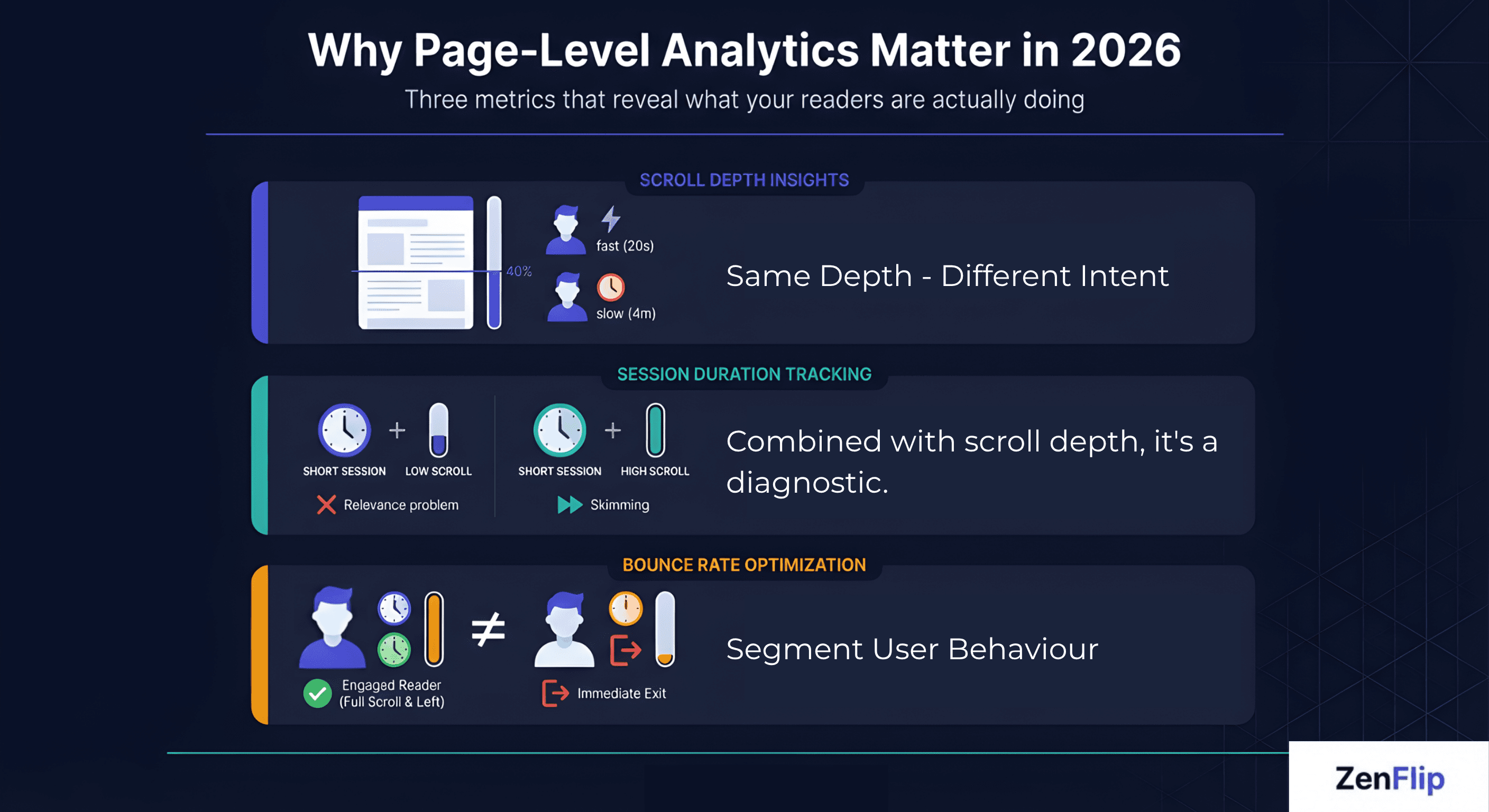
Digital publishing analytics has matured considerably. In 2026, the most actionable signals come from page-level data - engagement metrics tied to individual sections of a page rather than the page as a whole. Three metrics sit at the centre of this approach.
Scroll Depth Insights
Scroll depth insights measure how far a reader progresses through a piece of content. When this data is mapped against your content structure, patterns emerge quickly. If a consistent portion of readers stops at the same subheading or paragraph, that location is a reader drop-off point worth investigating.
Scroll depth is most useful when combined with time-on-section data. A reader who reaches 40 percent of your content in under 20 seconds is behaving very differently from one who takes four minutes to get to the same point. The combination reveals whether the issue is relevance, readability, or something structural.
Session Duration Tracking
Session duration tracking measures the total time a reader spends with your content. In isolation, it is a blunt instrument. Combined with scroll depth and interaction data, it becomes a precise diagnostic tool for content performance audits.
Short session durations paired with low scroll depth typically point to a relevance problem - readers arrived expecting something different from what they found. Short session durations with high scroll depth often indicate skimming behaviour, which signals a structural issue rather than a content one.
Bounce Rate Optimization
Bounce rate - the percentage of readers who visit a single page and leave without further interaction - remains a core user engagement metric in 2026. The shift is in how it is interpreted. A reader who exits after spending several minutes with your content and scrolling to the bottom has behaved very differently from one who leaves in the first few seconds.
Bounce rate optimization now means segmenting that behaviour and responding to each pattern separately, rather than treating bounce rate as a single number to reduce.
Page-Level Analytics for Annual Reports and Long-Form Publications:
Annual reports are typically the longest document an organisation publishes, the most expensive to produce, and the one with the most diverse intended audience. Shareholders, employees, regulators, journalists, and prospective investors all approach the same document with different information needs and different reading behaviours. Understanding where each group drops off - and why - requires data that aggregate view counts simply cannot provide.
Interactive annual report software built on a page-level analytics foundation gives publishers a granular view of how their report is actually being read.
Which financial tables hold attention the longest?
Does the CEO letter get read in full or does it prompt immediate skipping to the financials?
Where does the read completion rate drop below the threshold where key strategic messaging is landing?
ZenFlip's page-level analytics, available on the Creator plan, surface scroll depth and time-on-page data at the individual page level for every published flipbook. For a 100-page annual report, this means publishers can identify with precision which sections are working and which are losing readers - and act on that data before the next publication cycle.
The combination of page-level analytics and AI reader engagement publishing 2026 data creates a compounding intelligence loop. Page analytics show where readers drop off. AI Chat interaction patterns show what those readers were looking for when they left. Together, they give publishers not just the location of the problem but a strong signal about its cause - information that makes every subsequent annual report more effective than the last.
For organisations evaluating interactive annual report software specifically, the question to ask is not only whether the platform publishes a readable document, but whether it generates the page-level data needed to improve the next one.
How to Conduct a Content Performance Audit
A content performance audit applies reader behavior analysis to your existing content library - identifying which pieces retain readers, which lose them and where, and what factors are driving the difference. A useful audit in 2026 covers:
Scroll depth mapped to specific content sections
Session duration relative to expected read time
Reader drop-off points identified at the paragraph or heading level
Mobile rendering - layout issues on smaller screens are a consistent and underreported source of reader drop-off points
Content structure - long unbroken blocks of text, missing subheadings, and poor visual hierarchy are among the most common drivers of early exit
Building a Content Retention Strategy Using Page-Level Data
A content retention strategy that uses digital publishing analytics as its foundation follows three steps:
Identify - Use scroll depth insights, session duration tracking, and user engagement metrics to locate reader drop-off points across your content library.
Diagnose - Understand the root cause. Is it structural - a long unbroken block of text? A relevance mismatch? A mobile layout issue? A headline that does not match what the content delivers?
Fix - Address the specific cause. This might mean adding a subheading, tightening a paragraph, breaking up a dense section, or restructuring the opening to better match reader intent.
The fix is rarely as complicated as the diagnosis. The hard part is having the data to know what to fix and where. That is where page-level analytics in 2026 changes what is possible.
How ZenFlip Supports Reader Drop-Off Analysis
ZenFlip is an interactive digital flipbook publishing platform with page-level analytics built into every publication.
ZenFlip gives publishers and content teams scroll depth insights, session duration tracking, and reader behavior analysis at the page level - making it straightforward to identify reader drop-off points across a publication and act on what the data shows. For content teams who want to move from creation to performance without managing separate analytics infrastructure, ZenFlip covers both in one platform.
Explore More on ZenFlip

Looking for more insights on digital publishing, accessibility, sports, technology and more? The ZenFlip Library has you covered. Browse our full collection of free interactive magazines.
Every topic. One place. Read free at ZenFlip | Library
Frequently Asked Questions:
What are reader drop-off points?
Specific locations in your content where readers stop engaging and leave before finishing. They tend to cluster around structural or relevance issues and are identified through scroll depth and exit tracking data.
How is scroll depth tracked?
As a percentage of how far a user scrolls before leaving. Most platforms track at 25%, 50%, 75%, and 100% thresholds, though custom points are available. Mapping this to your content structure shows exactly where drop-off occurs.
What does session duration measure and what are its limitations?
The total time between a user's first and last event in a session. Its key limitation is that it does not measure active reading - an open tab with no activity still registers time. Most useful when combined with scroll depth rather than read in isolation.
What is the difference between page-level analytics and site-level analytics?
Site-level gives aggregate data across your whole website. Page-level gives data specific to individual pages or content sections - where readers scroll, where they exit, how long they spend in each section. Page-level is what makes pinpointing drop-off possible.
What content factors most commonly drive reader drop-off?
Headline and content mismatch, long unbroken paragraphs, missing or unclear subheadings, slow page load times, and poor mobile layout. These are structural and relevance issues, fixable without rewriting the content itself.
What is a content performance audit?
A systematic review of existing content using engagement data - scroll depth, session duration, and exit rates - to identify which pieces are retaining readers and where drop-off is happening. Used to prioritise fixes based on actual behaviour rather than assumptions.
How does ZenFlip support reader drop-off analysis?
ZenFlip is an interactive digital flipbook publishing platform with page-level analytics built into every publication, giving content teams scroll depth, session duration, and reader behaviour data at the page level. More at zenflip.io.
#ReaderDropOff #PageLevelAnalytics #ContentRetention #DigitalPublishing #UserEngagement #ScrollDepth #ContentPerformance #ReaderBehavior #BounceRate #ZenFlip
Turn your next PDF into a flipbook — free
No credit card, no watermarks, no time limits. 5 publications on the free plan — ready in under 2 minutes.