How to Build a Branded Digital Publishing Platform and Sell Content Directly
A branded digital publishing platform can help businesses launch their own storefront, sell content directly to readers, and take control of their content monetization - without relying on third-party marketplaces.

Written By: Jagadish C U (Founder Of Zentrovia Solutions)
For businesses that publish digital content regularly - commercial publishers, associations, research firms, and media companies - a branded digital publishing platform can offer a direct path to readers: content delivered under the publisher's own domain, inside their own visual identity, with full control over revenue, reader data, and the experience from first click to final page.
This post covers how a direct-to-reader publishing setup can work in practice, with ZenFlip as the primary reference throughout.
How a Branded Digital Publishing Storefront Works
A branded storefront on a digital publishing platform serves the publisher's catalog from a domain they control. Readers land on the publisher's URL, browse publications presented under the publisher's visual identity, and complete purchases without being redirected to a third-party marketplace interface.
On ZenFlip's Enterprise plan, the storefront is hosted on the publisher's own domain. Publications, collections, and subscription offerings are all presented as the publisher's product. Once a reader opens a publication, ZenFlip's white-label viewer - available from the Business plan upward - removes all platform branding from the reading interface. The reading experience carries only the publisher's logo and colours throughout.
Custom domain configuration on ZenFlip uses a CNAME DNS record. The platform describes the setup process as taking under five minutes.
Revenue Models Available on a Direct-to-Consumer Publishing Platform
Direct Sales and Reader Subscriptions
ZenFlip's Enterprise plan supports both one-off publication sales and recurring reader subscriptions. Content can be grouped into collections and priced independently. Publishers keep 90% of revenue from each sale - the platform charges a monthly licence fee rather than collecting a large transaction share on each purchase. A revenue dashboard and payout management are included, giving publishers a consolidated view of earnings across their full catalog.
Direct-Booked Advertising
For publishers with a sizable readership, advertising can function as a revenue channel alongside subscriptions rather than as a replacement for them. ZenFlip's Business plan and above includes a native advertising stack - direct-booked ad slots on publication pages, with CPM, CPC, or flat-fee billing options. Viewability is measured to MRC standards (50% of the ad's pixels visible for at least one continuous second). Advertisers access their own campaign data through a signed-link portal, without requiring a platform account and without visibility into the publisher's other campaigns or rate card.
Read: ZenFlip | Features | Ads
Day-to-Day Operations on a Digital Publishing Platform
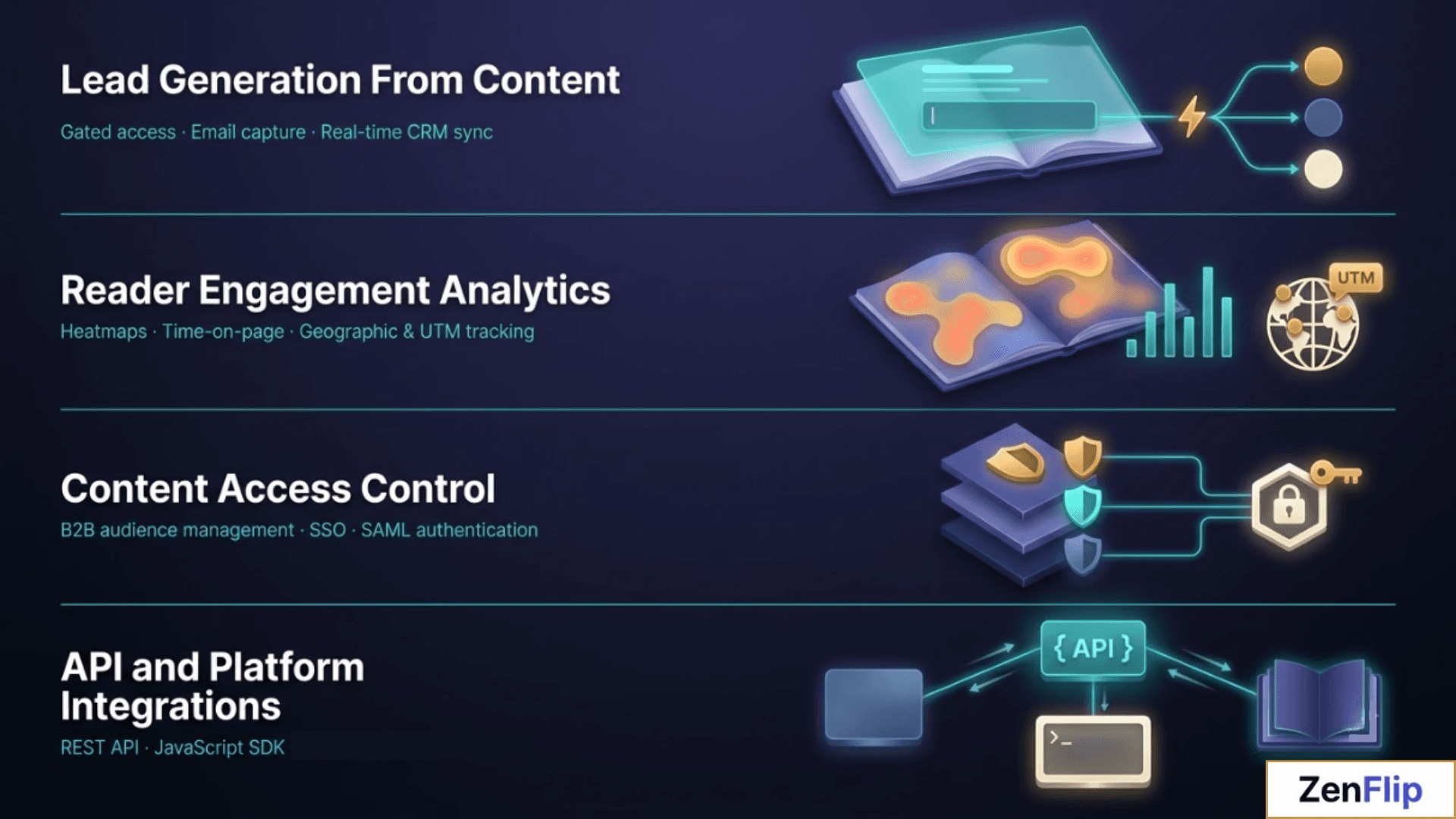
Lead Generation From Content
ZenFlip supports gated content, where readers provide an email address before a publication opens, as well as built-in lead capture forms that appear during reading. Each form submission triggers a real-time Zapier webhook, connecting to CRM and marketing tools including HubSpot, Salesforce, and Mailchimp - among 5,000 or more apps supported through the Zapier integration.
Reader Engagement Analytics
ZenFlip's Business plan includes page-level heatmaps, time-on-page tracking, geographic data, device breakdown, UTM tracking, and data export. Publishers can see engagement broken down per page across every publication - not just aggregate view counts. UTM parameters in publication links support campaign attribution in external analytics platforms.
Content Access Control
For publishers delivering content to defined business audiences, ZenFlip's Enterprise plan includes B2B content delivery and access control features, allowing publishers to manage which audiences can access which publications. SSO and SAML authentication are also available on the Enterprise plan for organisations that require identity federation.
API and Platform Integrations
ZenFlip's Business plan includes REST API access and a JavaScript SDK, giving development teams programmatic control over the flipbook viewer. This covers custom sizing, event hooks, and dynamic content loading for publishers building the platform into an existing CMS or web application.
Accessibility Standards in Digital Publishing
All ZenFlip plans include an interface designed to align with WCAG 2.2 AA standards. This covers text-to-speech with real-time word highlighting, a dyslexia-friendly reading mode through ImmersiveReader, screen reader support built on ARIA, and keyboard navigation with 15 or more shortcuts. These features are included on every plan tier - not gated behind an upgrade.
ZenFlip also includes ZenGuy, an AI reading assistant available across all plans. Readers can ask questions about a publication's content in natural language and receive answers with citations linking back to the source page.
For publishers distributing content to institutional or public-sector audiences, accessibility alignment is increasingly part of procurement requirements rather than an optional feature.
Read: Your Complete Guide to Accessible Digital Publications in 2026
Evaluating a Digital Publishing Platform for B2B Use
A direct publishing setup tends to be worth evaluating when content is a primary product rather than a supporting asset, when the volume or value of content makes platform fees a material cost, or when the business needs direct access to reader data that a third-party platform does not expose.
ZenFlip offers a free Explorer plan for publishers who want to test the platform before committing to a paid tier. Business and Enterprise plans unlock the full range of white-label branding, custom domain, storefront, and monetization features. ZenFlip's pricing is covered by a Price Lock Pledge - the rate at signup is never increased without 90 days written notice and explicit consent. Enterprise pricing is available through ZenFlip's sales team at zenflip.io. Check out the ZenFlip Library App - For Mobile - On Google Play Store
Frequently Asked Questions (FAQ)
What is a branded digital publishing platform?
A branded digital publishing platform is software that allows businesses to publish and distribute digital content under their own domain, branding, and reader relationships - rather than hosting content on a third-party marketplace that carries the platform's own identity.
How does a branded storefront differ from hosting content on a third-party platform?
With a branded storefront, readers access the publisher's content through the publisher's domain and interface. There is no visible third-party platform branding. On ZenFlip's Enterprise plan, the storefront, the reading experience, and the purchase flow all carry only the publisher's identity.
What revenue does ZenFlip retain from publication sales?
ZenFlip's Enterprise plan allows publishers to keep 90% of revenue from each sale. The platform charges a monthly licence fee rather than collecting a large share of each transaction.
Can subscriptions and advertising run on the same platform?
Yes. ZenFlip's Enterprise plan supports reader subscriptions and content collections. The Business plan and above adds a native advertising stack with direct-booked slots, MRC-standard viewability measurement, and a signed-link advertiser portal - both revenue models can operate simultaneously.
What analytics data does ZenFlip provide?
ZenFlip's Business plan includes page-level heatmaps, time-on-page tracking, geographic and device data, UTM tracking, and data export. Publishers can view engagement data per page across every publication in their catalog.
How does lead capture work inside a ZenFlip publication?
ZenFlip supports gated content, where an email is required before a publication opens, and built-in lead forms that appear during reading. Submissions trigger real-time Zapier webhooks connecting to HubSpot, Salesforce, Mailchimp, and 5,000 or more apps.
What access control options are available for B2B content?
ZenFlip's Enterprise plan includes B2B content delivery and access control, allowing publishers to manage audience-level access. SSO and SAML authentication are also available for organisations requiring identity federation.
Does custom domain setup require a developer?
ZenFlip's custom domain uses a CNAME DNS record. The platform describes the process as taking under five minutes and does not indicate that developer involvement is typically required.
What accessibility features are included?
All ZenFlip plans include WCAG 2.2 AA-aligned features: text-to-speech with word highlighting, ImmersiveReader with dyslexia support, screen reader support on ARIA, and 15 or more keyboard shortcuts.
What is ZenFlip's Price Lock Pledge?
ZenFlip's Price Lock Pledge states that the rate at signup is never increased without 90 days written notice and the publisher's explicit consent. It applies across all paid plans.
#DigitalPublishingPlatform #B2BDigitalPublishing #SellDigitalContent #BrandedStorefront #ContentMonetization #DirectToConsumerPublishing #DigitalMagazineSoftware #ContentDistribution #WhiteLabelPublishing #PublisherTools
Turn your next PDF into a flipbook — free
No credit card, no watermarks, no time limits. 5 publications on the free plan — ready in under 2 minutes.